CCST Welcomes UC Santa Barbara’s Rachel Segalman, PhD, to Board of Directors

California Science Center Opens New Ecosystems Exhibit
April 1, 2010 | CCST Newsroom | Contact: M. Daniel DeCillis
The California Science Center, a public-private partnership between the State and the California Science Center Foundation located in Los Angeles, has been actively working for years to provide unique, hands-on educational experiences. On March 25, it added a major new exhibit to this roster when it opened the Ecosystems exhibit gallery.
“Science is not something you read about but something you do,” said Dennis Bartels, executive director of the Exploratorium in San Francisco. “You can no more be a swimmer without getting near the water. “We are all tuned in as human beings to learn about our world by interacting with it. In this age of seduction by pixels, we should all celebrate movements like the California Science Center to allow us all to get our hands dirty and delight in our senses.”
According to a 2009 study by the National Research Council, there is abundant evidence that informal science education settings, such as museums, aquariums, and after-school programs, are important contributors to people’s knowledge and interest in science.
“Informal learning is a vital part of teaching STEM [science, technology, engineering and mathematics],” said CCST Executive Director Susan Hackwood, who was present at the Ecosystems opening in Los Angeles. “For children, there is no substitute for this kind of hands-on experience. The whole notion of getting your hands wet, bringing the learning environment right up front and personal so you can smell the kelp so to speak, is exactly correct and makes a big difference.”

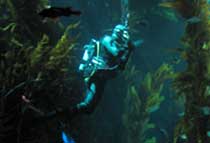
Ecosystems invites visitors to explore eight environmental zones illustrating different ecological principles ranging from the most ordinary and domestic to the most remote and inhospitable. The exhibits also vary in terms of scale, with one focusing on a very tight region – Los Angeles – and another focusing on the ways in which living and physical systems interact on a global scale. Visitors can learn about how isolation reveals the processes of evolution, explore how our own homes are habitats – even see how rot and decomposition release nutrients that nourish life. The highlight is a 24-foot-long transparent tunnel through a 188,000-gallon tank that puts visitors face to face with horn sharks, swell sharks, giant sea bass, wolf eels, bat rays and other fish swimming in a kelp forest.
The new exhibits nearly double the exhibition space of the Science Center, which expects at least 2 million visitors this coming year.
It is expected that the opportunities afforded by the Ecosystems exhibit will soon be integrated into the Science Center’s formal programs as well, many of which are developed through a multifaceted partnership with the Los Angeles Unified School District, both for K-12 students and for teacher professional development programs.
“People continue to learn their whole life,” said CCST Council member Jeffrey Rudolph, president and CEO of the California Science Center and the president of the California Science Center Foundation. “The best learning isn’t always happening in schools.”
“This is the beginning of authentic wonder and engagement that so often leads to innovation,” said Bartels. “CSC and its new Ecosystems area should be seen as an essential and vital part of the great Los Angeles education system.”