CCST Annual Report 2024-25

Insight to Innovation: Strengthening California Policy
Annual Report
Published: October 2, 2026 (Last Updated: October 2, 2026)
Overview
CCST’s 2025–26 Annual Report covers a year in which CCST expanded how it brings trusted, nonpartisan science and technology expertise to California policymakers. The report highlights two new programs: the Science Residency Program, which places senior Science Advisors in state government to advise executive leadership, and CCST’s first Legislative Academy, which prepares Capitol staff for fast-moving AI policymaking. It features our Science Advisor at the California Natural Resources Agency as well as our AI Science Advisors, placed at the Governor’s Office of Emergency Services and the California Department of Technology.
Readers will find highlights from Science & Technology Week and Science Day at the California Natural Resources Agency, an introduction to the 2025 CCST Science & Technology Policy Fellows, and updates on the 2025–2029 Strategic Plan and the latest Federal Labs Impact Report. The report closes with a tribute to outgoing Board Chair Peter Cowhey, along with CCST’s Strategic Plan goals, financial reports, and a recognition of 2025 donors.
The origin of CCST began with a simple idea: harness the power of California’s exceptional research institutions and technical talent to advance California’s status as a global leader in science and technology policymaking. Nearly 40 years later, CCST has fulfilled and expanded that charge.
Over the last year, we launched our Science Residency Program, embedding senior-level Science Advisors directly within state government to counsel executive leadership. The program builds on 17 years of experience running our flagship CCST Science & Technology Policy Fellowship.
We also launched our first-ever Legislative Academy to equip Capitol staff with the grounding they need for fast-moving technology policymaking in AI. Along with a cohort of AI Science Advisors placed at the Governor’s Office of Emergency Services and California Department of Technology, these efforts extend our commitment to the thoughtful integration of technical expertise into state policymaking, which includes a clear focus on frontier AI governance and safety, from policy advising in the Legislature to regulatory implementation in the Executive Branch. Neither program existed a year ago. Both now shape how California governs one of the most consequential technologies of our time.
Our annual events, Science & Technology Week and Science Day, brought policymakers, researchers, and industry leaders together to form deeper partnerships. Our 2025-2029 Strategic Plan lays out a clear vision for CCST’s next chapter, and our latest Federal Labs Impact Report highlights the essential value of California’s federal laboratories to the state’s economy, security, and scientific leadership.
None of this happens without the extraordinary community that surrounds CCST — our staff, our Fellows and alumni, our Partner Institutions, the Distinguished Experts and collaborators across all of our programs, and the policy officials who trust us to bring them credible, nonpartisan counsel. We are grateful to be part of it, and optimistic about what we will accomplish together in the year ahead.
With determination and partnership,
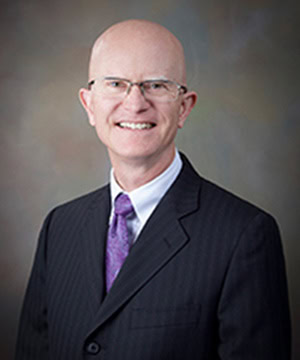
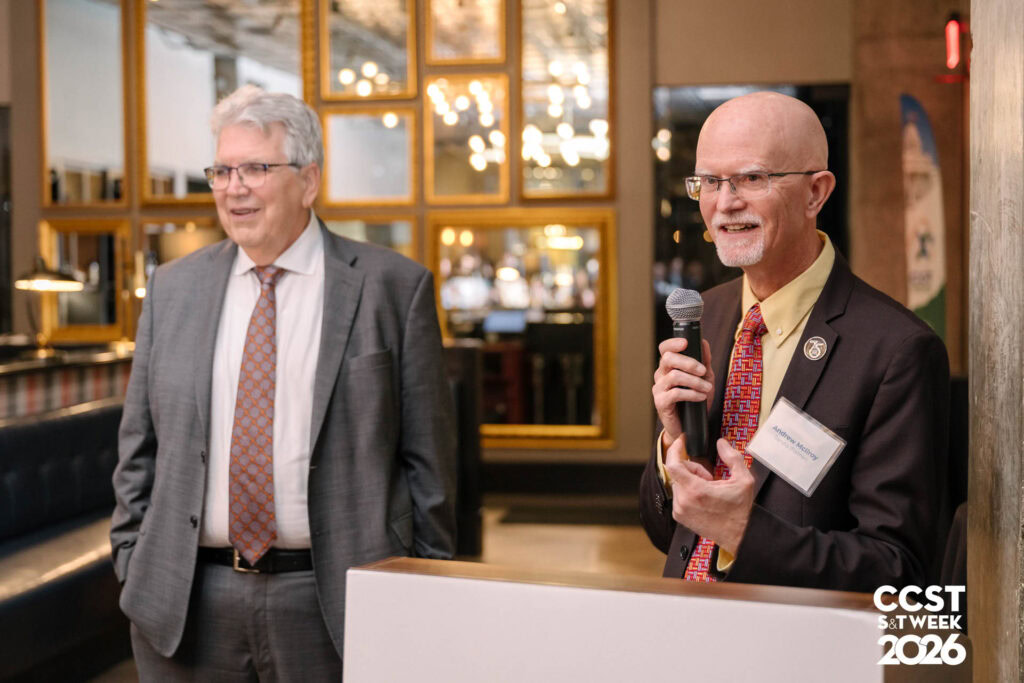
Andrew McIlroy, PhD
Chair, Board of Directors
Associate Labs Director
(Retired) Sandia National Laboratories
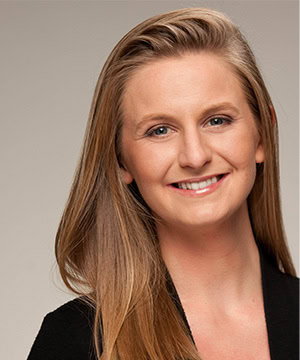
Julianne McCall, PhD
CEO
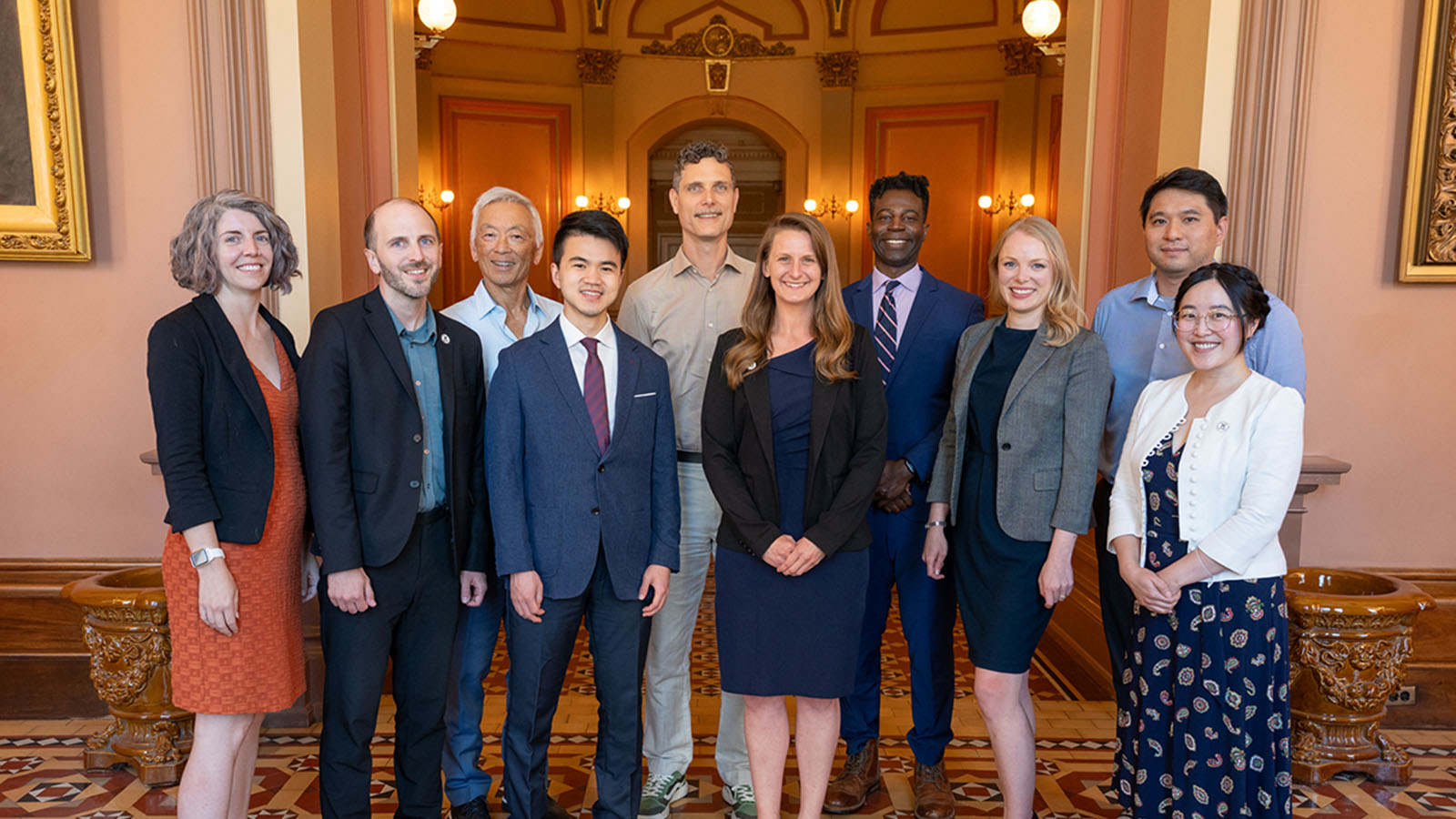
In January 2026, CCST marked the beginning of its new Science Residency Program when we welcomed Dr. Andrew D. Jones as the inaugural Science Advisor to the California Natural Resources Agency (CNRA) in the office of Secretary Wade Crowfoot. Dr. Jones brings 15 years of experience as a researcher at Lawrence Berkeley National Laboratory and now advises CNRA leadership on climate resilience, biodiversity, wildfire, clean energy, water management, and ecosystem health.
A connector across sectors, Dr. Jones is also leading several initiatives to embed science more deeply into the agency’s work, including connecting state leaders across a new inter-agency science council and organizing science symposia to connect CNRA’s efforts with the broader scientific communities.
With the passage of nation-leading frontier AI safety legislation in SB 53 (2025, Wiener), California needed high caliber, expert talent to support implementation across its agencies. A pivotal moment, the size and capabilities of frontier AI models continued to advance rapidly as the competition for talent in the AI workforce was fierce.
In Summer 2026, CCST placed three AI Science Advisors to advise the executive branch on frontier AI safety, risk assessment, and the implementation of new AI safety legislation: Michael Chen and Lawrence Chan at the Governor’s Office of Emergency Services (Cal OES) and Dr. Justin Norman, at the California Department of Technology (CDT).
CCST’s strength lies in our nimbleness, independence, and adaptability. Depending on the need and timeline, we can deliver peer-reviewed reports, convene the right partners at the right time, place invaluable expertise directly inside state government, or provide rapid, independent analyses of complex scientific questions. Whatever the format, our commitment stays the same: reliable, nonpartisan advice, powered by a world-class partner network.
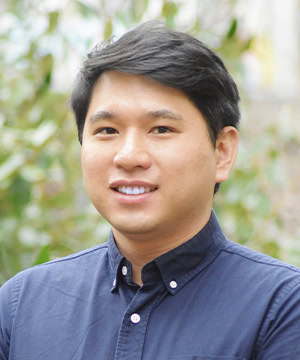
— Eric Chu
Beginning Fall 2026, CCST will place a Science Advisor on Emerging Technologies with a joint appointment to the Governor’s Office of Business and Economic Development (GO-Biz) and the Labor and Workforce Development Agency, extending the Science Residency model into California’s innovation economy. Meanwhile, our AI Science Residency Program will grow this fall with the hiring of Senior AI Fellows at each agency, who will serve as technical advisors on state-level AI policy and governance.
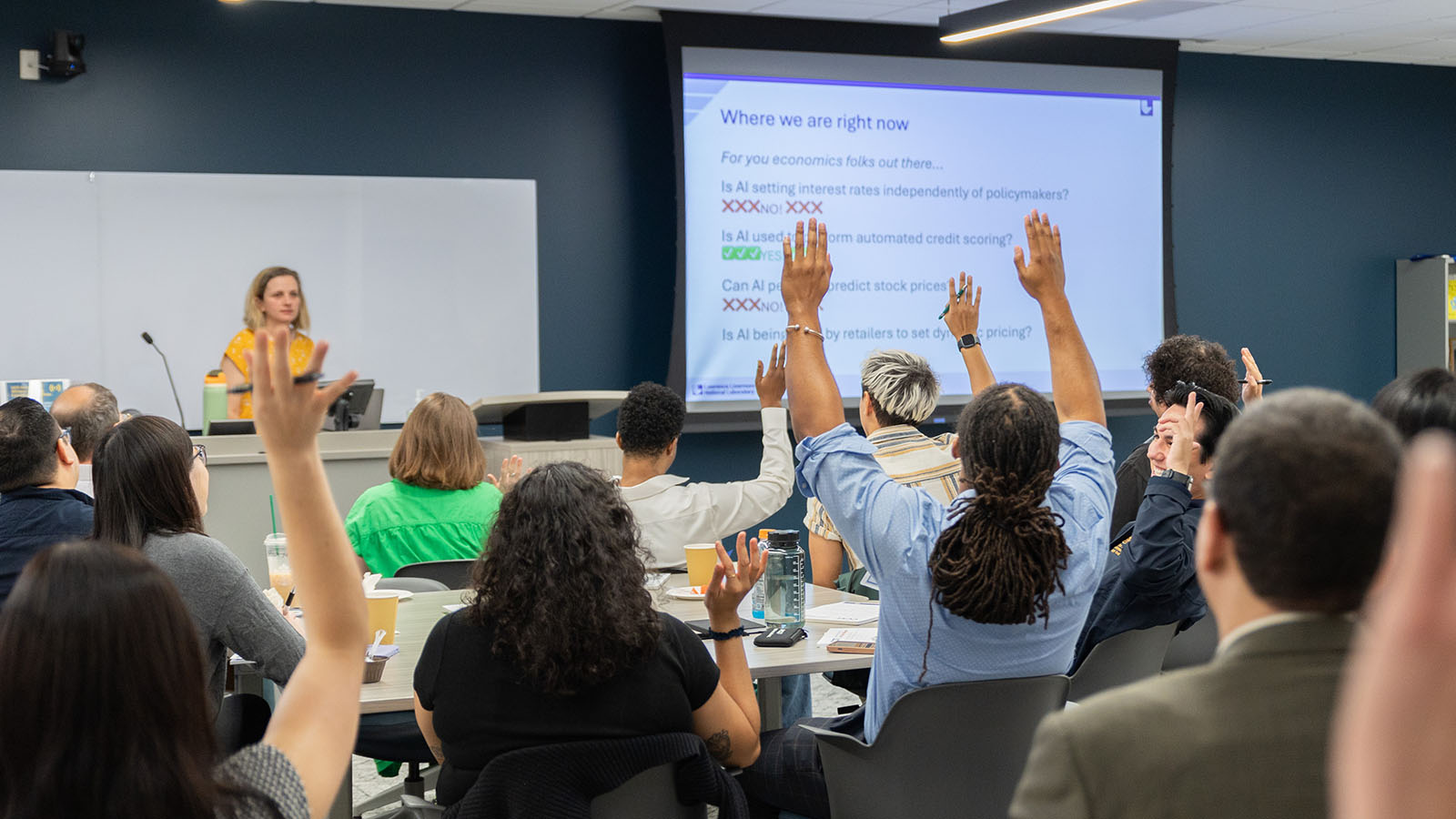

CCST launched its AI Policy Initiative to keep science at the center of California’s fast-moving AI conversation. This past year, we expanded the initiative to build lasting infrastructure for policymakers.
With more than 50 AI-related bills introduced in the 2025 legislative session, California’s legislative staff needed trusted, nonpartisan ways to build AI fluency fast. In response, CCST launched its Legislative Staff Academy on AI.
The Academy launch delivered four key events:
Across the events, legislative staff learned about core topics related to AI including what the technology can and can’t do, implications for intellectual property law, effects on California’s workforce and economic competitiveness, and how it’s being deployed across industries from software to healthcare to research.
The AI Academy provides grounded, actionable understanding in a rapidly evolving landscape, supporting California’s leaders as they shape AI-related policy and strategy.
— Héctor Corzo
The academy began its cohort-based training sessions in September 2026, hosting seminars across key topics in AI policy and providing a forum to discuss late-breaking events and challenges. By cultivating a core cohort of Legislative staff, the AI Academy will build a community of practice in the AI policy space, while providing drop-in opportunities for additional staff who wish to engage on specific aspects of the curriculum.
Taken together, the AI Academy and AI Science Residency program represent CCST’s AI Policy Initiative growing into a pillar for supporting policymakers’ efforts to determine how California governs the technology, from the Legislature drafting bills to the Executive Branch implementing regulations.
Powered by Partnership
AI Academy and Residency Program made possible by philanthropic contributions including Omidyar Network, Kapor Foundation, and Ralston Family Fund in collaboration with placement agencies.
CNRA Science Advisor
Placement is in partnership with the Gordon and Betty Moore Foundation.
CCST Expert Briefings address urgent and emerging issues facing California policymakers. As part of our ongoing Disaster Resilience Initiative, CCST completed a four-part Climate Change and Human Mobility briefing series in partnership with the UC Disaster Resilience Network and the UC Berkeley Institute for Security and Governance. The series examined how climate-driven displacement is reshaping housing, insurance, and community resilience for Californians and communities beyond the state’s borders.
Additional Expert Briefings spanned topics as diverse as “AI Tools for Addressing Conservation and Biodiversity,” “Preparing California’s Energy Grid for New Load Sources at Scale,” and “Natural Capital as Infrastructure.” CCST expert briefings provide a trusted space for policymakers to learn about complex topics facing California’s ecosystems, communities, and economy.
CCST’s convening power was in full effect this year and included a new partnership with the California Department of Water Resources (DWR). In September 2025, ahead of Science Day, CCST supported DWR in mounting its inaugural Water Resources Science Symposium, “Science Drives Our Decision-Making,” bringing together water resources professionals from across the state to explore the science shaping California’s most pressing water challenges.
Responding to a request from the California Department of Pesticide Regulation (DPR), CCST conducted a multi-phase study on fumigant use in California and available alternatives. The study, which includes three peer-reviewed reports and proceedings from an expert convening, gives regulators an independent basis for decisions on chemicals that growers, workers, and neighboring communities all have a stake in.
We continued our energy work with a 2025 update to CCST’s primer for energy policy, “Key Challenges for California’s Energy Future.” Authored by CCST Senior Science Officer Rhianna Hohbein, PhD, under the guidance of an expert Steering Committee chaired by Jane Long, the primer explores the top eight energy challenges facing California and has become a go-to resource for energy staffers. Selected topics were informed by interviews with policymakers and 30+ leading energy experts across California’s academic and research institutions.
CCST has a long history of placing Fellows at Cal OES (our first Executive Fellow Nicole Meyer-Morse ‘14 was placed with Cal OES well before we fully expanded the program in 2020 to include Executive Branch offices). In 2026, we made CCST history by placing two AI Science Advisors at Cal OES to support implementation of SB 53 and to advise on other frontier AI safety challenges.
Given our names, it was only a matter of time before we collaborated with CDT. In 2026, we placed an AI Science Advisor with CDT –– one of the first two placements in the program –– to help implement their core responsibilities as defined in SB 53 and to keep pace with the rapidly advancing AI field and bills heading their way.
CCST’s value lies in our ability to leverage our network and build partnerships that advance science-supported policymaking in California. As California’s challenges don’t come one at a time or in one shape, neither does our work. We endeavor to connect our S&T partners and policymakers with whatever the moment calls for.
— Ope Oyewole
In addition to supporting their inaugural Water Resources Science Symposium, CCST is working with DWR to develop guidelines for using AI tools to generate plain language summaries of DWR-led scientific research publications.
CCST is working with the CWDC to modernize California’s water data infrastructure, collaborating with a range of issue-area experts to develop the appropriate stakeholder coalition.
CCST is partnering with the Bay-Delta Science Conference planning team, offering several in-depth trainings on how to effectively communicate with policymakers, and is a proud “Delta Smelt Tier” sponsor of the event.
Building on an established partnership with LCI, CCST is providing technical research and copyediting support for the California Fifth Climate Change Assessment’s 15 Core Climate Research reports.
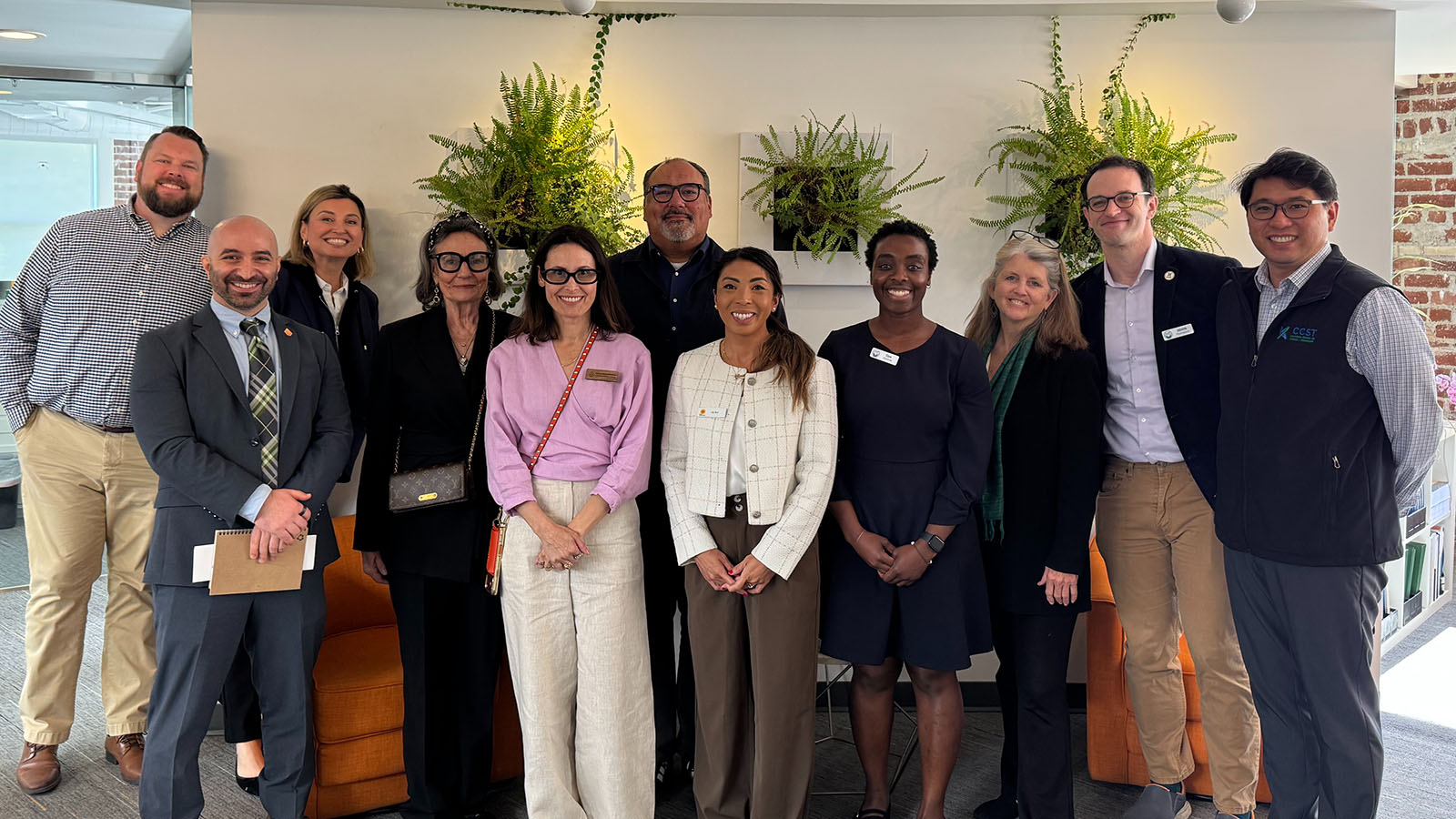
Pictured: In partnership with CWI, CCST is advising the Legislature on wildfire policy. Modeled after CCST’s legislative science services, their first policy memo, on home hardening standards, was published in June 2026.
Coming Soon
CCST is excited to partner with GO-Biz in placing an Emerging Technology Science Advisor and starting an Executive Branch Emerging Technology Academy.
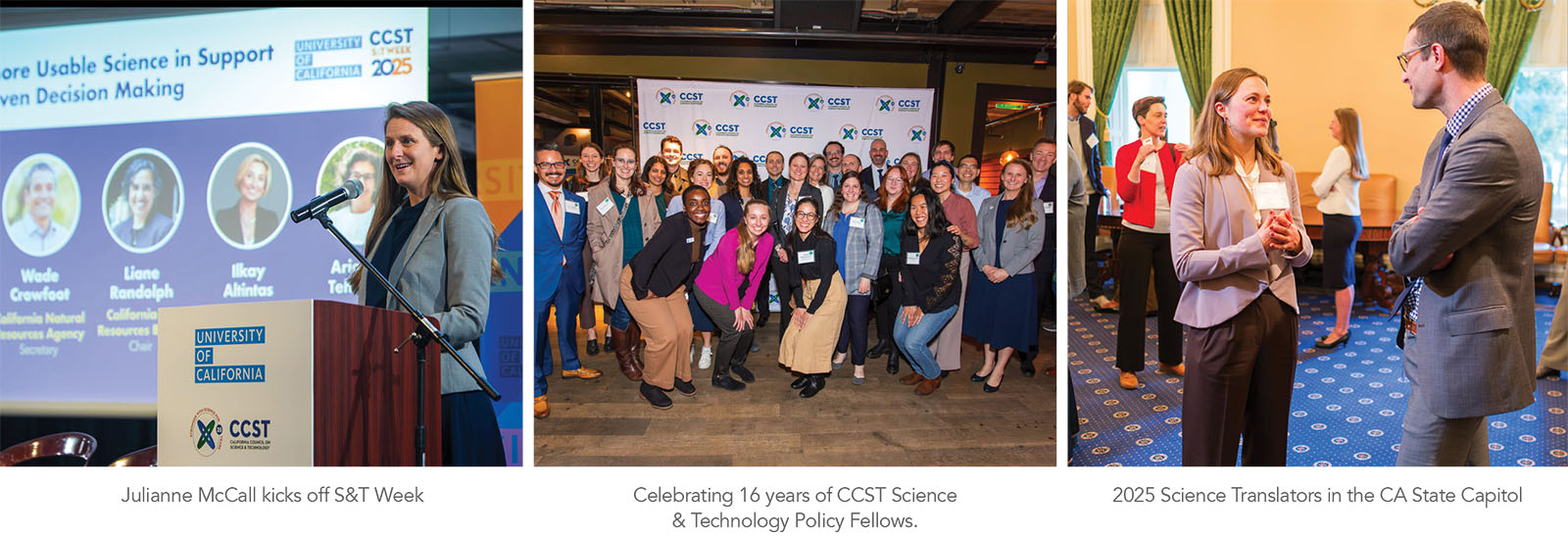
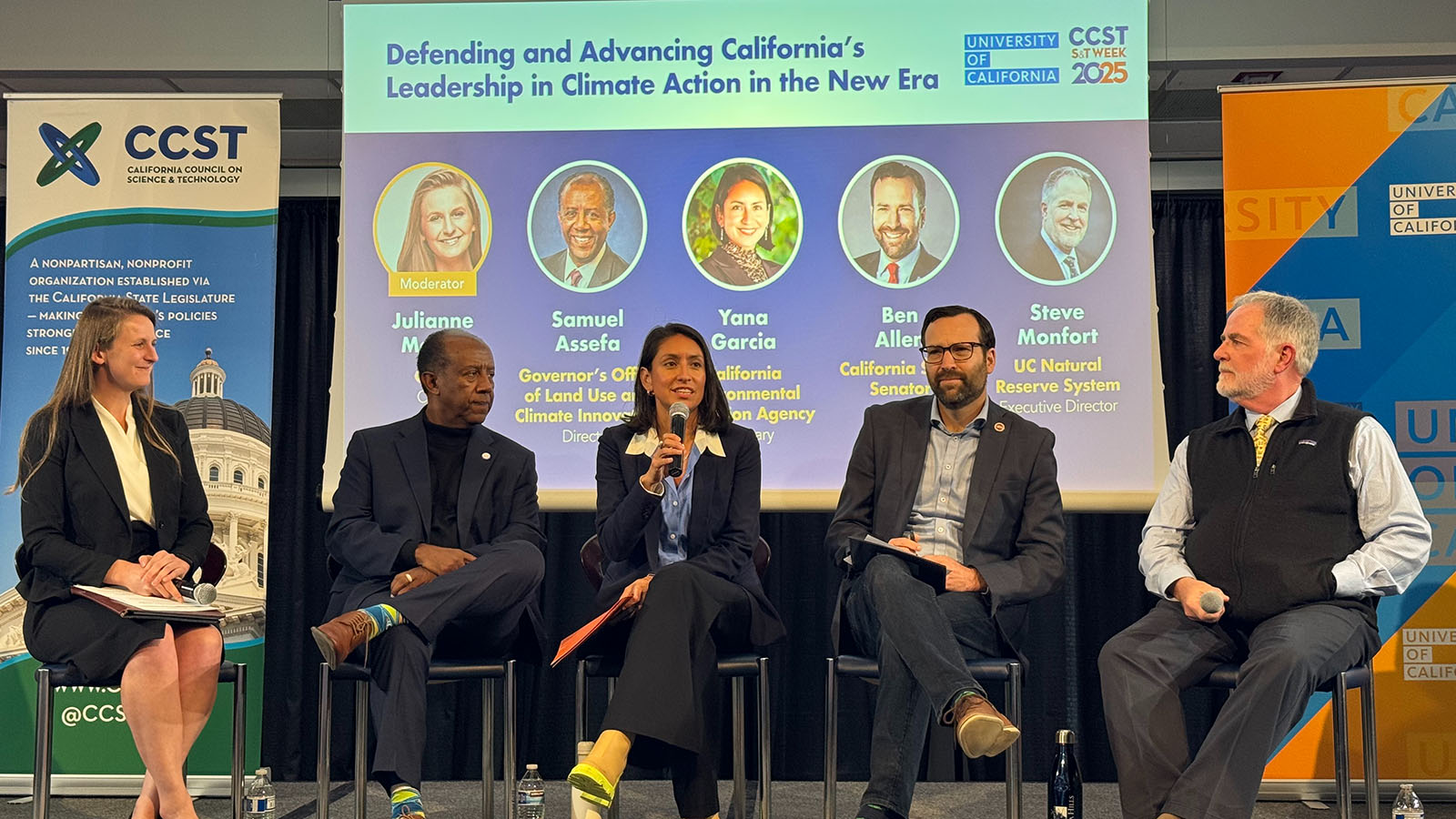
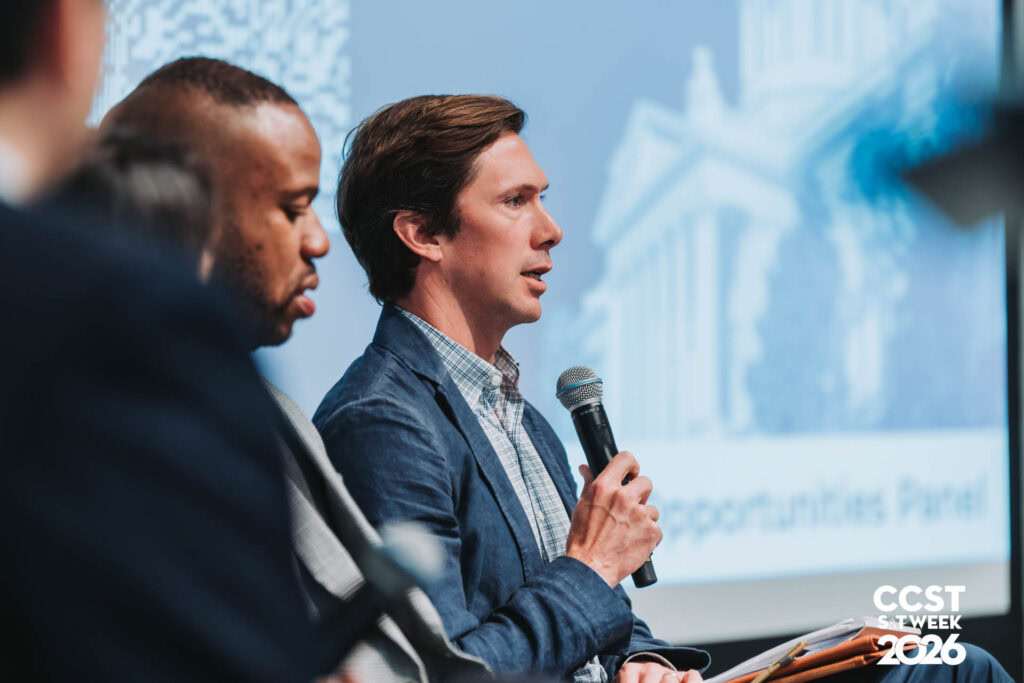
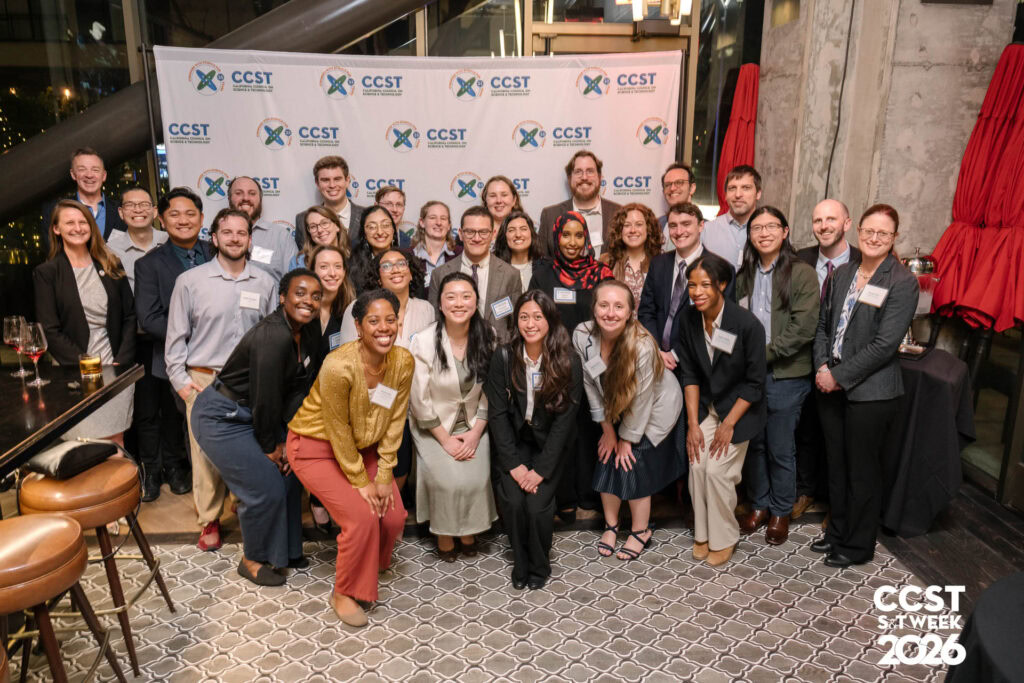
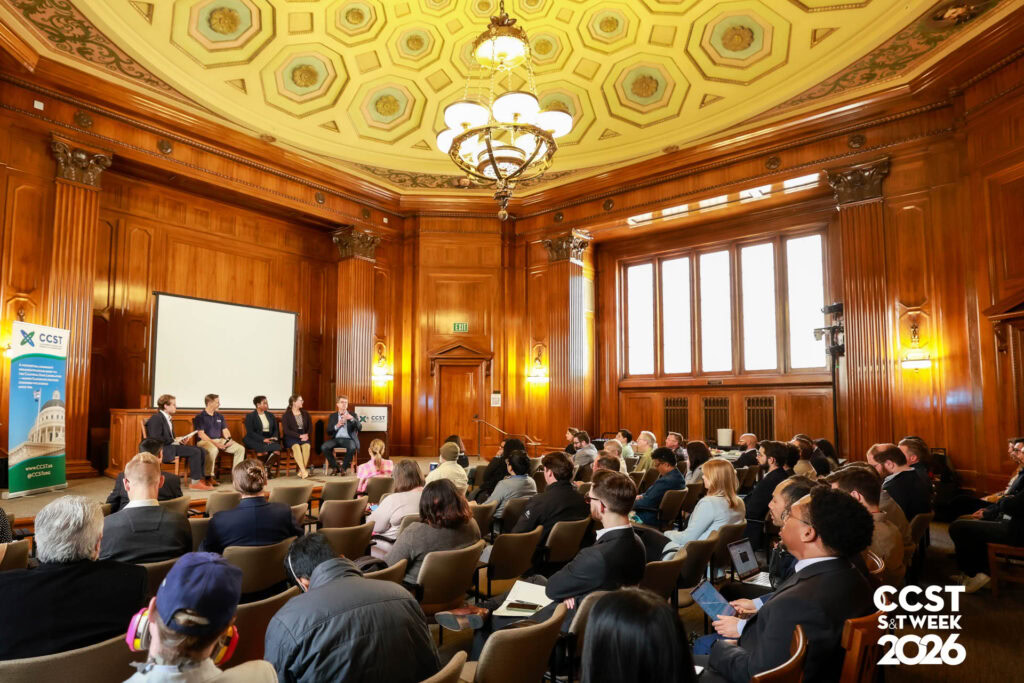
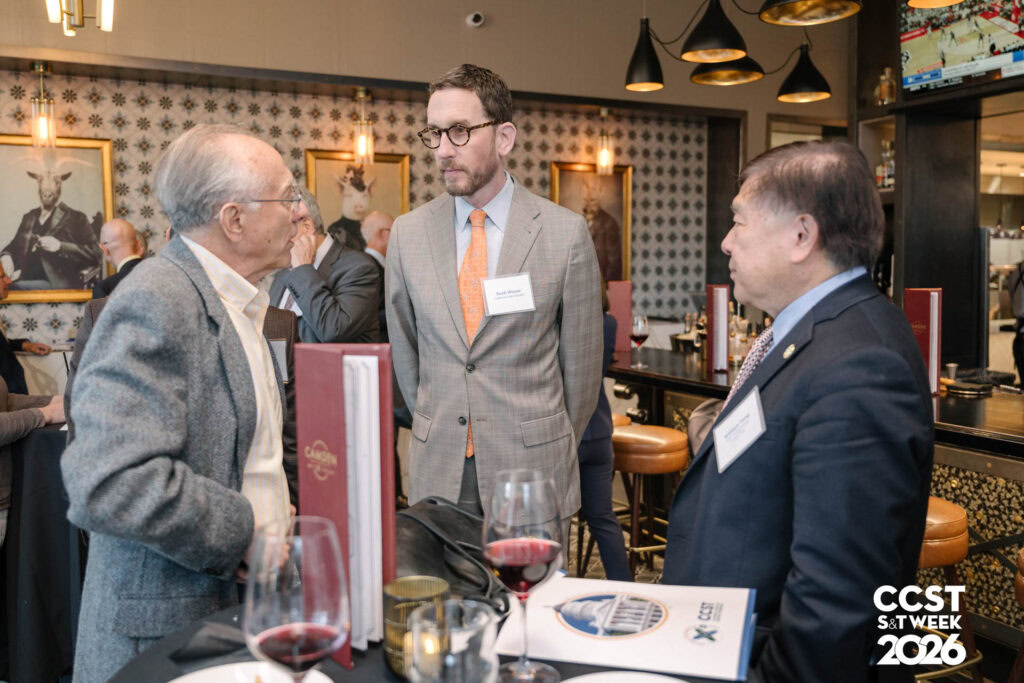
S&T Week opened with a keynote on usable science for data-driven decision-making, in partnership with the UC Office of the President (UCOP) Research & Innovation team, and closed with an Expert Briefing on bridging the gap between research and policy. In between, we welcomed Science Translators in a showcase sponsored by the Office of Lieutenant Governor Eleni Kounalakis and celebrated 16 years of CCST Science & Technology Policy Fellows.
CCST’s 9th annual S&T Week kicked off with our inaugural Partnership Forum — a roundtable convening legislative and agency leaders, philanthropic partners, and CCST Board members to explore strengthening the resilience of California’s science-advice ecosystem. The week closed on a theme of partnership as well, with a UCOP-partnered panel on California’s climate research investments.
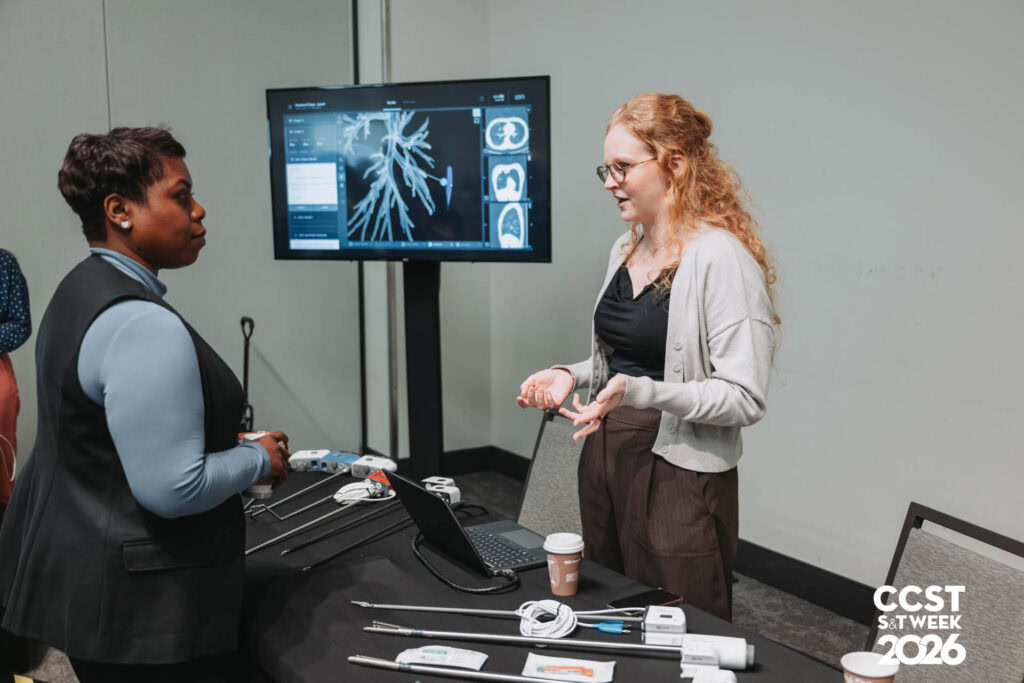
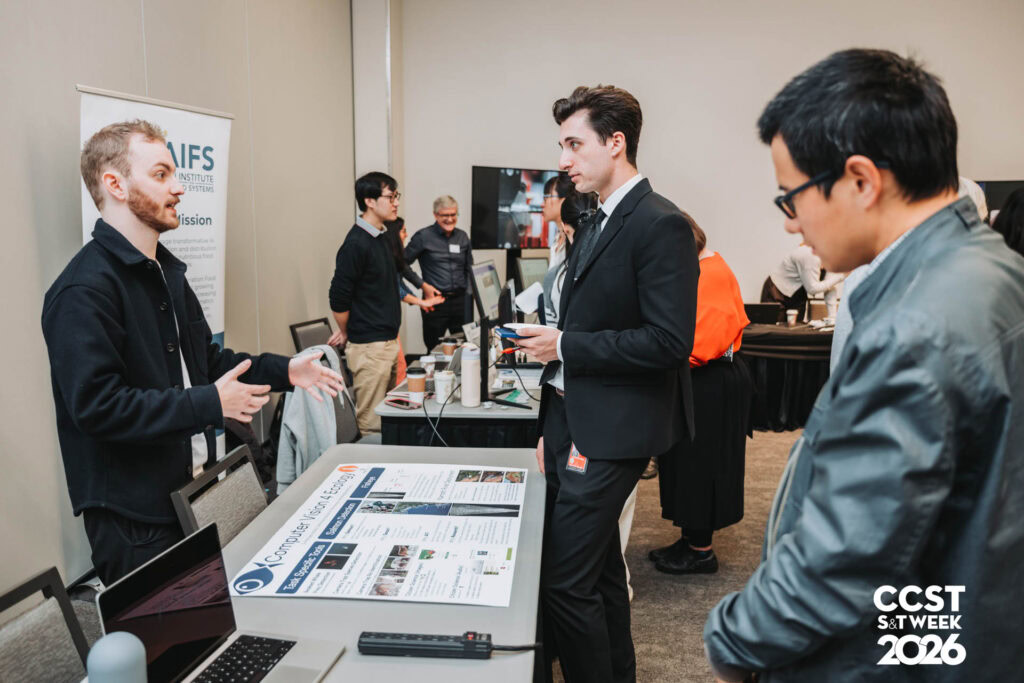
CCST’s AI-in-Action Showcase, held in collaboration with the Silicon Valley Leadership Group, brought nine displayers — including Adobe, Caltech, FutureHouse, Lawrence Berkeley National Laboratory, SAP, and UC Davis — to demonstrate real-world AI applications for legislative and executive staff, capping the launch phase of the Legislative Staff Academy on AI. Two panels followed, on trust in the AI age and AI as an engine for scientific discovery.
The closing panel, on Quantum Innovation in California, brought together IBM, Lawrence Berkeley and Lawrence Livermore National Laboratories, and Rigetti Computing, moderated by GO-Biz Deputy Director of Innovation and Emerging Technologies Trelynd Bradley to discuss California’s quantum research infrastructure and workforce pipeline.
CCST’s Science in Public Service Awards acknowledge public servants with track records of prioritizing science and technology issues and who actively value efforts to connect science to policy.
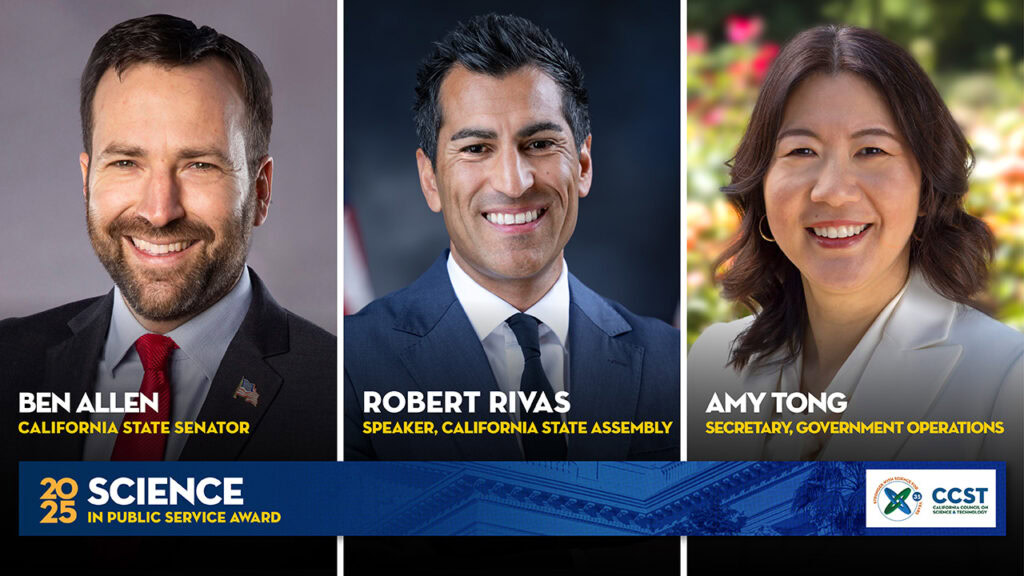
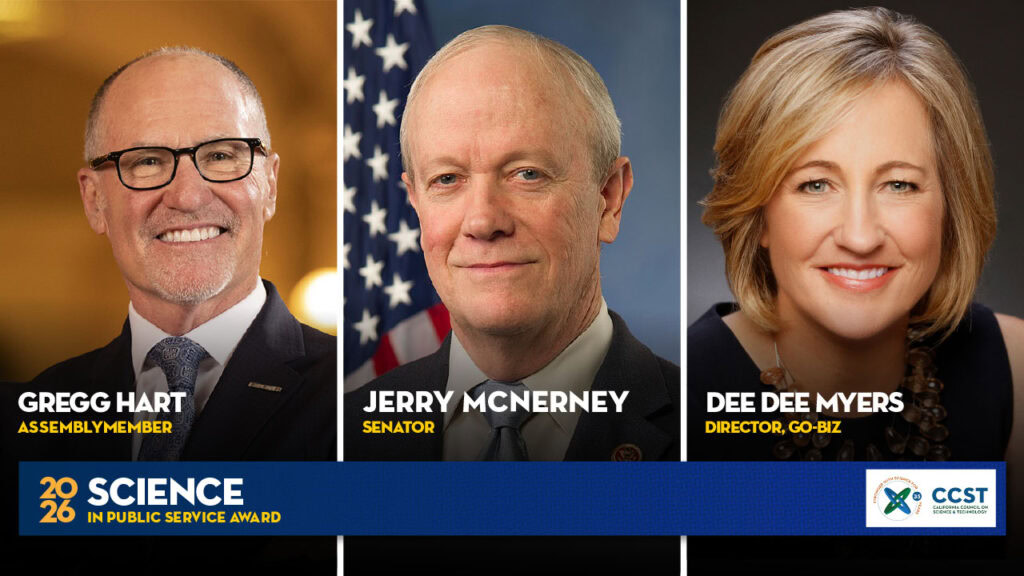
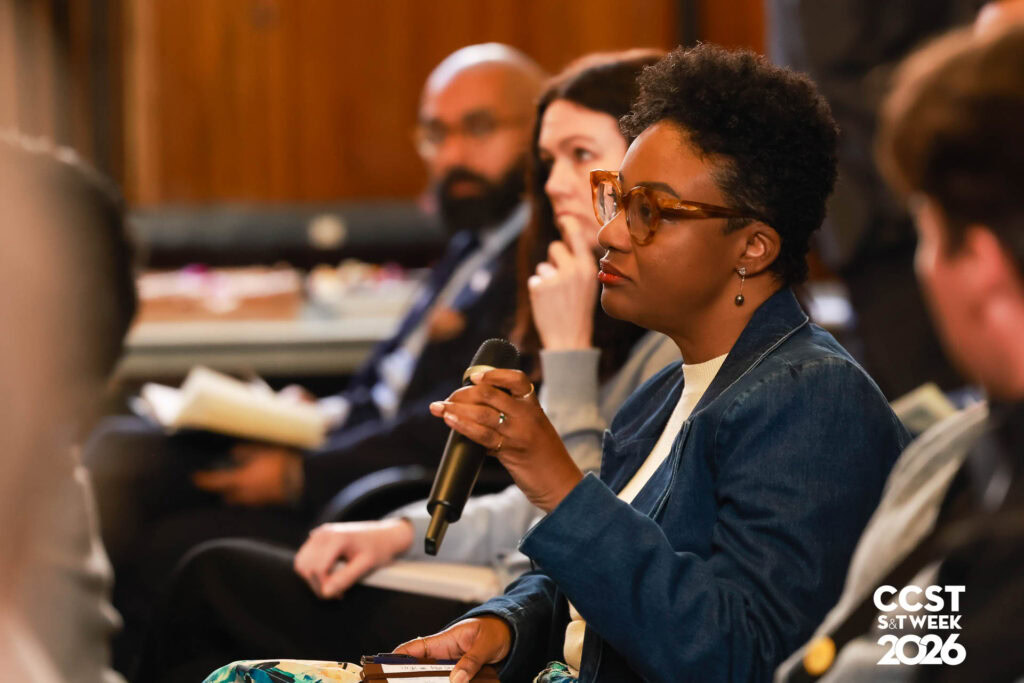
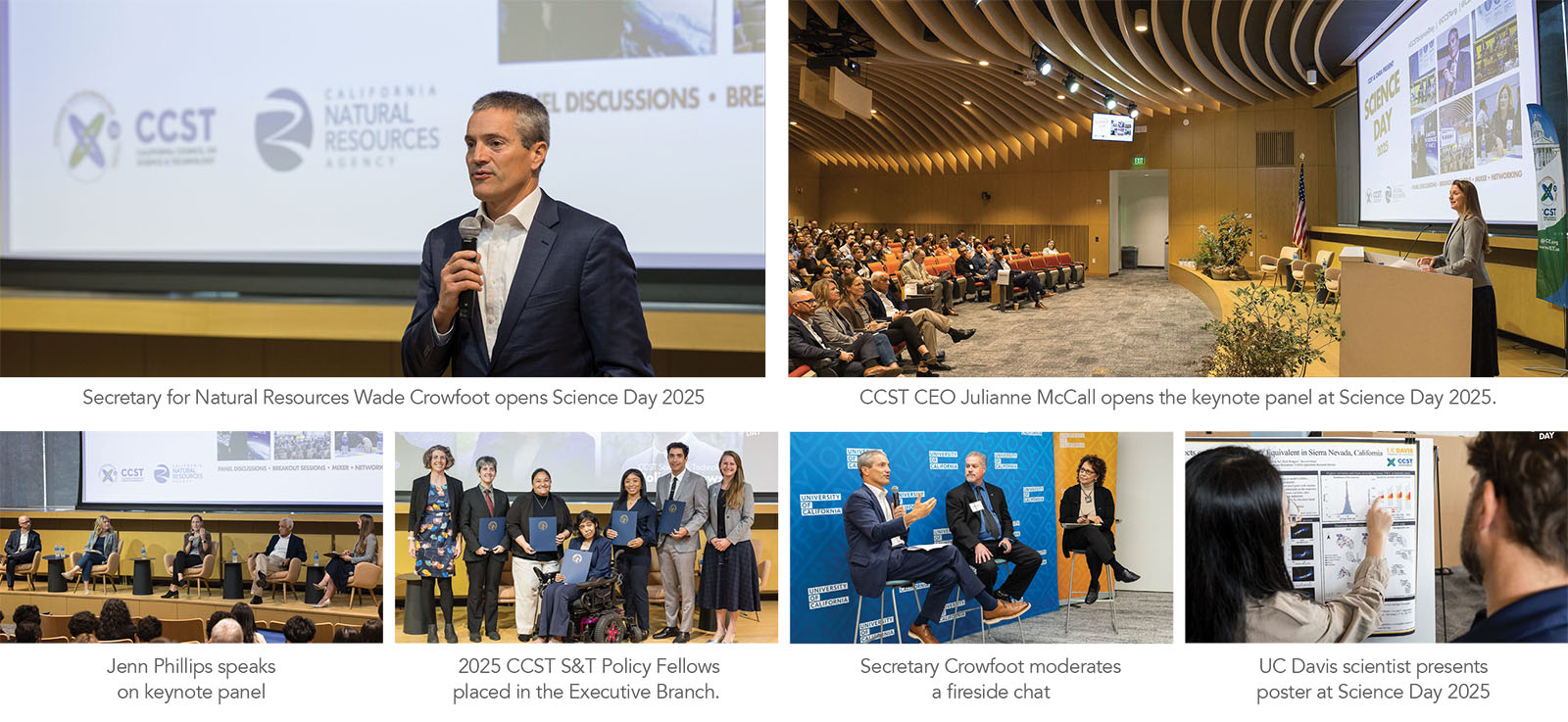
On September 29, 2025, CCST and the California Natural Resources Agency (CNRA) engaged more than 400 scientists, policymakers, and partners at CNRA headquarters in Sacramento for the third annual Science Day.
The power of collaboration was on display — from the keynote panel on sustaining partnerships, to breakout sessions on nature and health, data and technology, and climate planning, to the conversations at the poster session, career center, and networking mixer.
The keynote panel brought two examples of state-science partnership to the stage. The first traced back to a conversation at CCST’s inaugural Science Day in 2023: a partnership between the State and NASA’s Ames Research Center that has since grown into the Wildfire, Ecosystem Resilience, and Risk Assessment (WERK) Initiative, now backed by $30 million in state funding. In 2025, that partnership delivered California’s first-ever statewide high-resolution ecosystem monitoring dataset — a shared win, advancing state priorities while deepening research capacity.
Another example, California’s Fifth Climate Change Assessment, is a state-academia partnership that will contribute to the scientific foundation for understanding climate-related vulnerability throughout California, with author and reviewer teams that extend beyond academia to include community and tribal partners.
Secretary Wade Crowfoot moderated a Fireside Chat with NASA Ames’ Anthony Colaprete, Director of Science (Acting), and CCST Board Member Theresa Maldonado, Vice President for Research and Innovation at the UC Office of the President. The conversation explored California’s scientific enterprise, the state’s role in supporting science in uncertain times, and what it takes to sustain partnerships like WERK for the long haul.
Science has never been more important. The partnerships that are growing in this room and across the state are more critical than ever.
– Natural Resources Secretary Wade Crowfoot
More than 50 researchers presented at the poster session, spanning state and federal agencies, universities, national labs, and nonprofits, on topics from biodiversity to wildfire to water and energy. Attendees also connected directly with representatives from five state departments — CAL FIRE, the Department of Water Resources, California State Parks, the Department of Conservation, and Caltrans — to explore career pathways and opportunities.
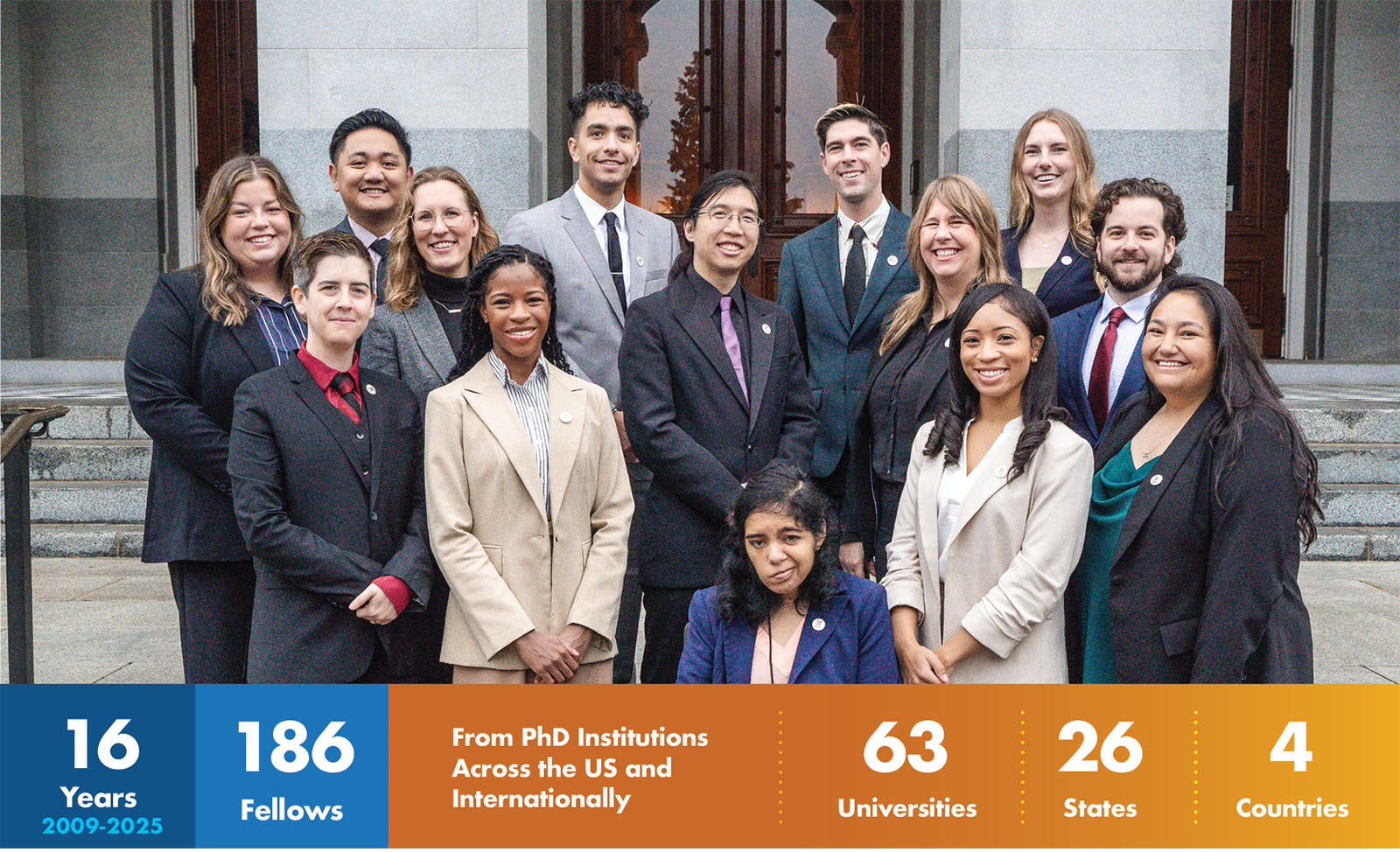

This is a program that I continue to praise for the caliber of the Fellows that it produces every year… It brings together our scientific community and policymaking and has such a valuable impact on our legislative process.
— Senator Ben Allen
“As the chair of the Senate Environmental Quality Committee, the CCST Science Fellows program is particularly near and dear to my heart. Last year, EQ became the first committee in legislative history to have all three of its consultant positions filled with Science Fellow alumni.”
— Senator Catherine Blakespear
The 2025 Fellows brought exceptional talent, passion, and conscientiousness to their placements in the Legislature and throughout the Executive Branch. I continue to be impressed by their commitment to serving California and desire to support the state’s long-term future through science-informed policy.
— Bethany Hopkins
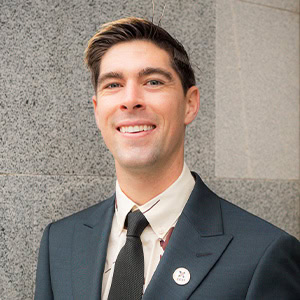 John Bennett, PhD
Assembly Privacy and Consumer Protection Committee
Originally from Southern California, John undertook studies in identifying novel drug targets in the parasite that causes malaria.
PhD: Chemistry, Stanford University
BA: Biochemistry, Classical Studies, Colgate University
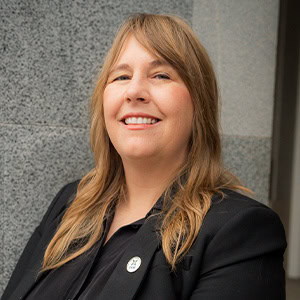 Kristen Koenig, PhD
Assembly Utilities & Energy Committee
Born and raised in Sacramento, Kristen has researched and led a lab studying the evolution and development of visual systems across animals.
PhD: Cell & Molecular Biology, University of Texas at Austin
BA: Molecular and Cell Biology; History, UC Berkeley
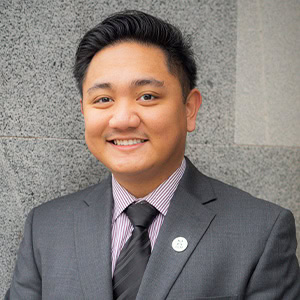 Aron Judd “AJ” Mendiola, PhD
Assembly Transportation Committee
Born and raised in the Philippines before immigrating to Los Angeles county. AJ moved to Davis to study epigenetics in neurodevelopment.
PhD: Biochemistry, Molecular, Cellular, Developmental Biology, UC Davis
MS: Chemistry, Biochemistry Option, Cal State LA
BS: Biochemistry, Cal State LA
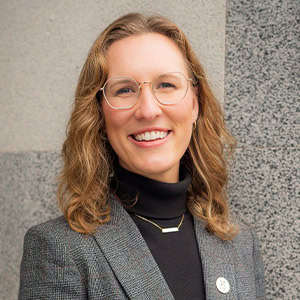 Julia Mouat, PhD
Assembly Local Government Committee
Born and raised in Ann Arbor, Michigan, Julia moved to northern CA to study multigenerational genetic and environmental risk factors for autism.
PhD: Integrative Genetics and Genomics, UC Davis
BS: Microbiology, University of Pittsburgh
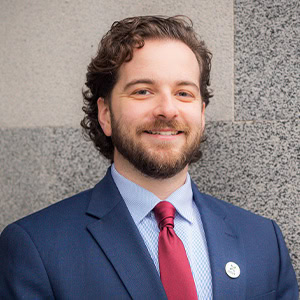 Adam Cooper, PhD
Senator Ben Allen
After moving from the Florida coast to San Diego, Adam studied how pollution in the ocean becomes airborne and which chemicals people are inhaling.
PhD: Atmospheric Chemistry, UC San Diego
BS: Chemistry, Stetson University
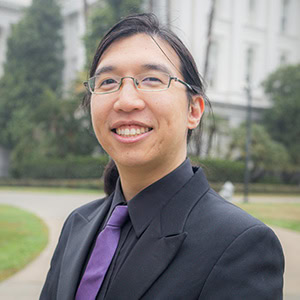 Benjamin Lu, PhD
Senator Catherine Blakespear
A self-effacing East Coast transplant, Ben studied how cognitive and biological constraints shape the human decision-making process.
PhD: Neuroscience, New York University
BS: Psychology, Princeton University
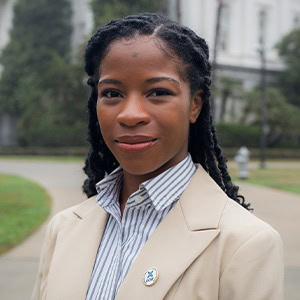 Taylor McKie, PhD
Senate Environmental Quality Committee
With a love for the environment and people, Taylor’s pursuing a career in climate policy to serve communities disproportionately impacted by climate change.
PhD: Oceanography, Scripps Institution of Oceanography, UC San Diego
BS: Environmental Engineering, Georgia Institute of Technology
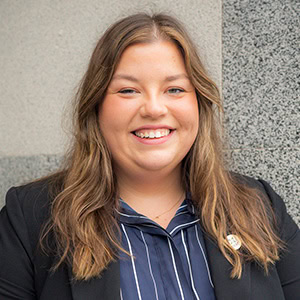 Jenna Roper, PhD
Senator Henry Stern
Arizona native and long-time Californian, Jenna developed low-cost diagnostic technologies to increase equitable access to healthcare.
PhD: Bioengineering, UC Riverside
BS: Bioengineering, UC Riverside
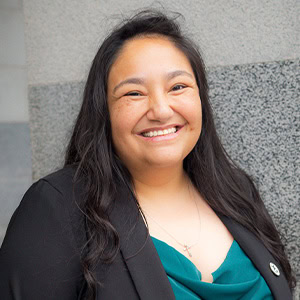 Jessica Bolivar, PhD
California Natural Resources Agency
Inspired by a professor who recognized her potential, Jessica embraced the opportunity to delve into the world of Cell and Molecular Biology, studying the molecular mechanisms that cells use to deal with stress.
PhD: Biochemistry, Molecular, Cellular, and Developmental Biology, UC Davis
BS: Biology with a concentration in Botany, SF State University
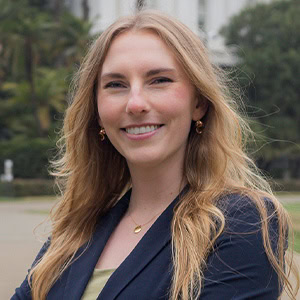 Hannah Griggs, PhD
California Energy Commission, Office of Chair Hochschild
An astrophysicist turned energy scientist, Hannah studied the cascading effects of outages on energy infrastructure.
PhD: Physics, Georgia Institute of Technology
BA: Physics & Mathematics, Bryn Mawr College
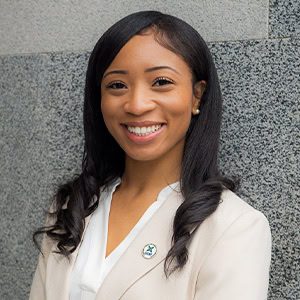 Ayana Henderson, PhD
California Department of Toxic Substances Control, Office of Legislation and Regulatory Review, California Environmental Protection Agency
Originally from the D.C./Maryland area, Ayana moved to Boston to explore the reproductive health effects of chemicals found in consumer products.
PhD: Biological and Biomedical Sciences, Harvard University
BS: Biological Sciences, University of Maryland, Baltimore County
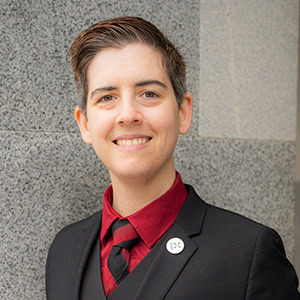 J Humphreys, PhD
Office of Environmental Health Hazard Assessment, California Environmental Protection Agency
Originally from Texas, they moved to California to study volcanic systems and pivoted to studying lithium in the Salton Sea Geothermal Field.
PhD: Geological Sciences, UC Riverside
BS: Geoscience, UT Dallas BA: Visual & Dramatic Arts, Rice University
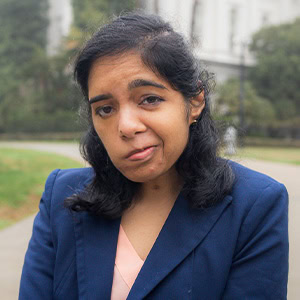 Raisa Rahim, PhD
California Department of Food and Agriculture
Given her lived experience, Raisa wants to expand beyond her research in child ADHD interventions into the environmental justice sphere.
PhD: Neuroscience, UC Davis
BS: Psychology, with an Emphasis in Biology, UC Davis
 Haynes Stephens, PhD
California Air Resources Board, Office of the Chair, California Environmental Protection Agency
A Bay Area native, Haynes studied climate change impacts on agriculture as well as transmission infrastructure for energy planning.
PhD: Geophysical Sciences, University of Chicago
BA: Astronomy & Astrophysics, UC Berkeley
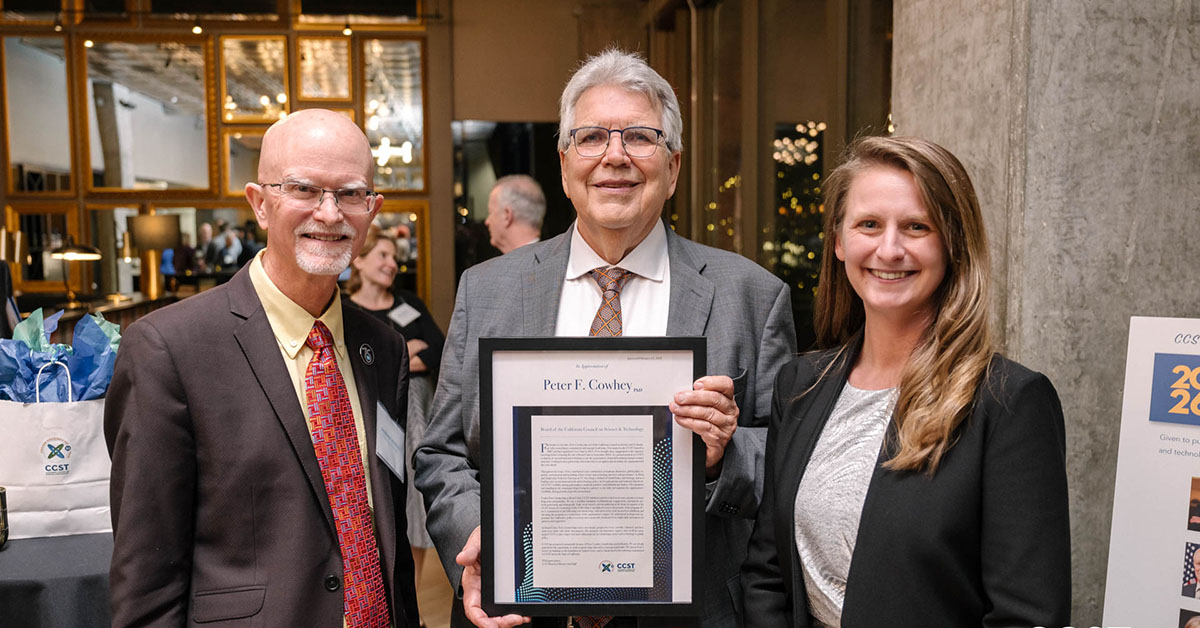
Effective March 2026, Dr. Andrew McIlroy was voted Chair of the Board of Directors, succeeding Dr. Peter Cowhey, who stepped down after eight transformational years as Board Chair and nearly two decades of service to CCST. Cowhey hands off an organization that has grown in reach, credibility, and impact across California’s science and technology policy landscape.
The strength of CCST has always come from the community behind it — the scientists, engineers, policymakers, and institutions working together.
— Peter Cowhey, PhD
During his tenure, CCST launched the Disaster Resilience and AI Policy Initiatives, established the Fellowship endowment, reimagined its advisory programs, and deepened its partnerships across California’s state agencies and research institutions. In addition to serving in the Clinton and Obama Administrations, Cowhey is Dean Emeritus and Qualcomm Chair Emeritus of the UC San Diego School of Global Policy and Strategy, where he served as dean from 2002 to 2021.
Dr. McIlroy joined the Board in 2020 and recently retired from Sandia National Laboratories, where he served as Associate Laboratories Director for Integrated Security Solutions and led the California laboratory. Over a more than three-decade career at Sandia, he held numerous leadership roles advancing national security, energy, and technology innovation. He brings that same cross-sector perspective to the role.
Science and technology for the public interest are essential to California’s long-term prosperity, economic resilience, and global leadership.
— Andrew McIlroy, PhD
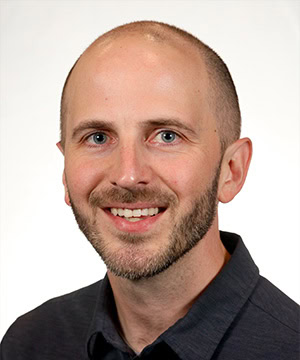

In 2025, after a considered process with Board and Staff engagement, we completed CCST’s new Strategic Plan. The plan guides CCST’s programmatic focus through 2029. To help implement our ambitous goals, we established a Strategic Initiatives wing at CCST.
Led by Mikel Shybut and Henriette Canino, the team spans science, communication, design, outreach, and fundraising. This interdisciplinary approach helps to coordinate across teams to support a cohesive, complementary path toward achieving our goals and objectives.
CCST exists to harness the abundance of scientific and technological expertise throughout the state. Our work relies on channeling partnerships across institutions to be a leading source of nonpartisan, world-class science and technology expert advice for policymakers.
Our strategic goals reflect our duty to provide policymakers with the very best evidence and insight the state has to offer, engaging leading experts to do so. Key objectives include our ongoing academy and science residency programs. By fostering strong connections between the science, technology, and policy communities, we help policymakers navigate complex challenges, anticipate emerging issues, and make decisions that ensure a resilient future.
2025-2029
Support California policymakers as a go-to partner for science and technology expertise, engaging our partner network and broader community to provide innovative programs, reliable advice, and resources to strengthen evidence-based policymaking.
Channel the nation’s brightest PhD scientists and engineers into public service in California and expand other opportunities to grow the next generation of science and technology policy leaders.
Provide forward-looking guidance to prepare policymakers for emerging issues, long-term trends, and technological change through expert insight and recommendations that ensure California’s resilience and continued science and technology leadership.
Foster a dynamic, readily-accessible network of science, technology, and policy experts who collaborate across sectors to generate innovative ideas and practical solutions for policymakers.
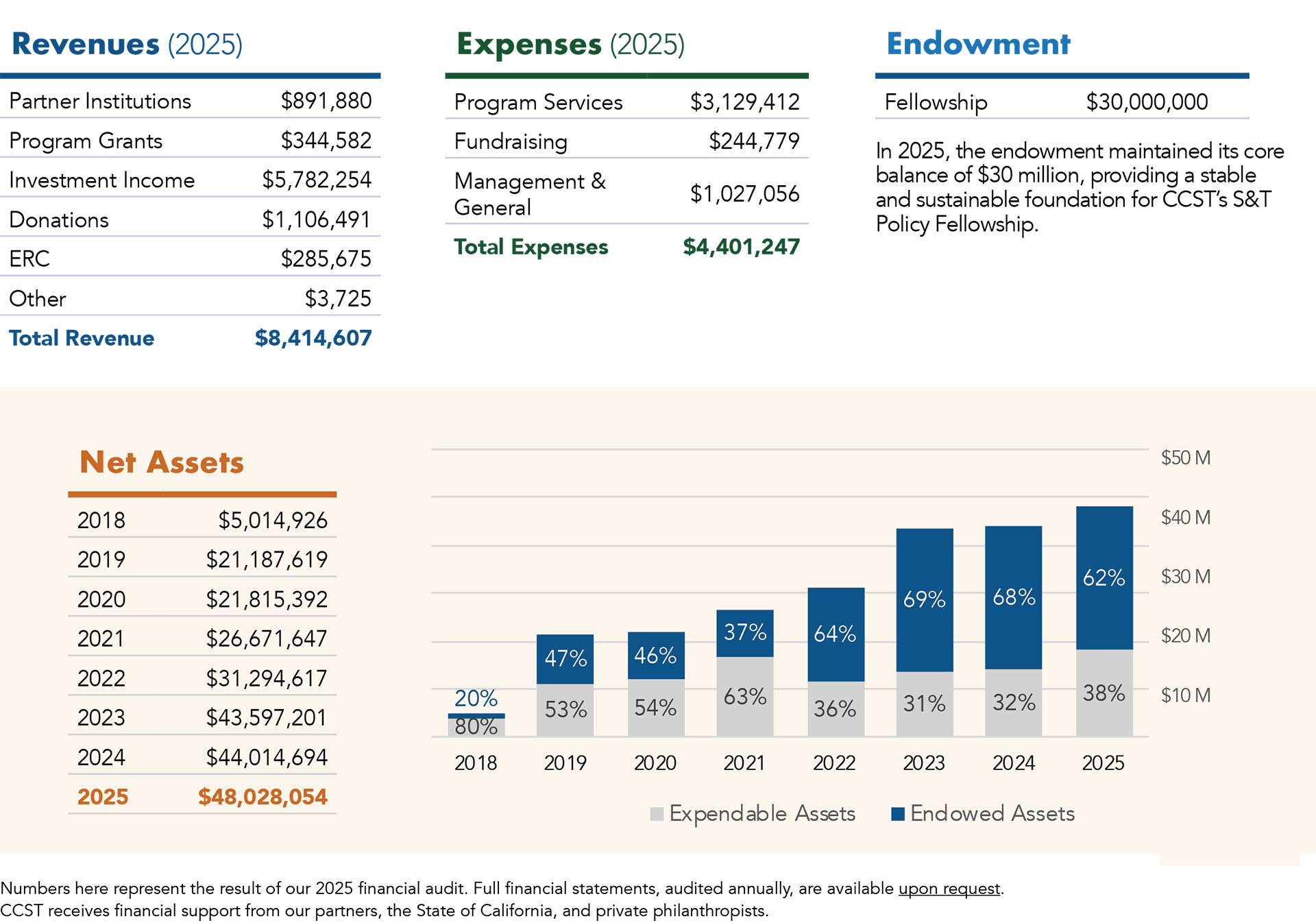
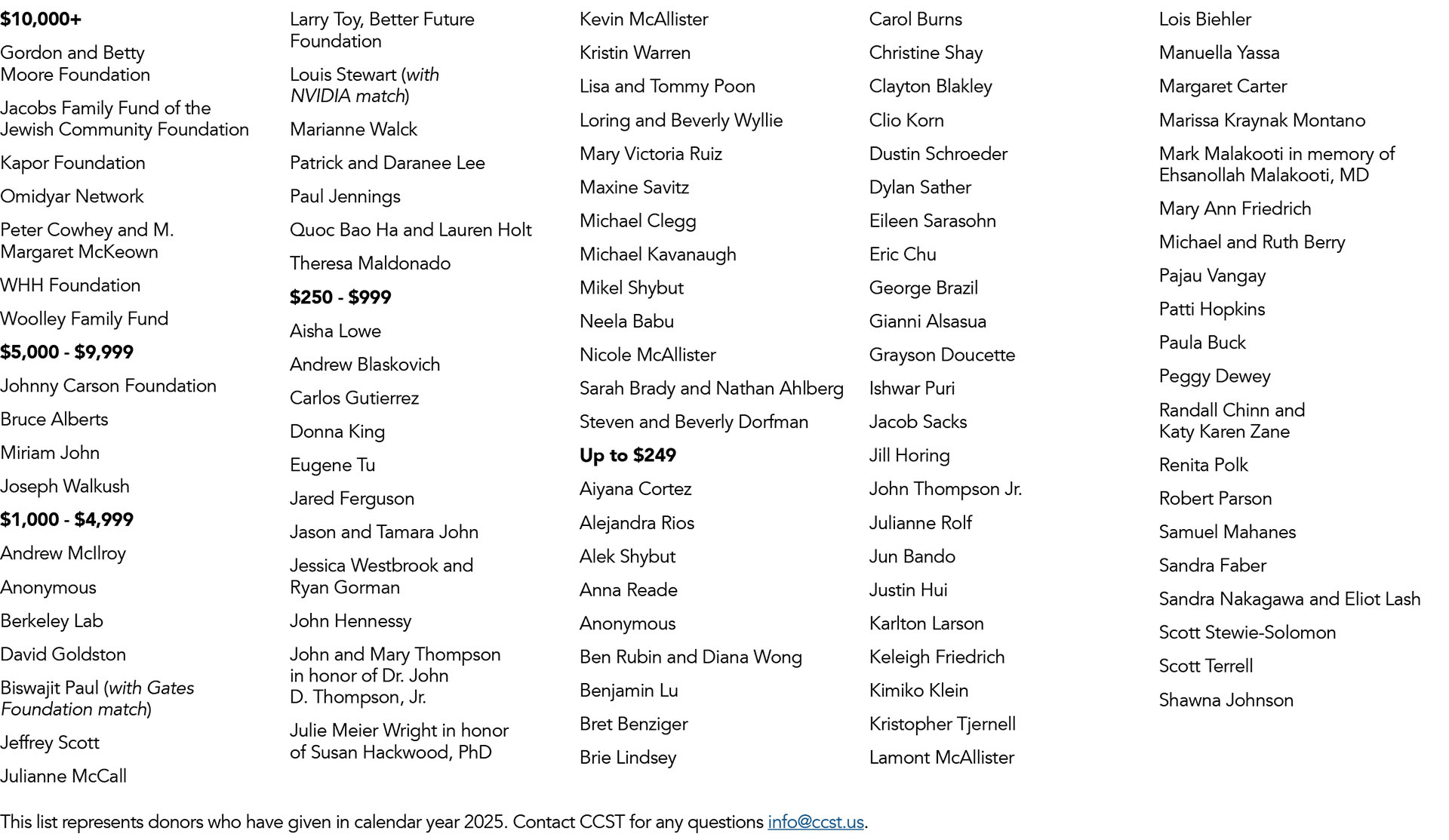
The California Council on Science and Technology is a nonpartisan, nonprofit organization that serves as a trusted source of expert science and technology advice for California policymakers—powered by a world-class partner network. CCST was established via a unanimous vote of the California State Legislature in 1988 to make California’s policies stronger with science and technology.
Serve as a trusted, nonpartisan source of expert science and technology advice for California policymakers, powered by a world-class partner network.
A resilient and prosperous California that thrives on partnerships between science, technology, and policy communities.
Keleigh Friedrich
Director of Communications
Project Manager
Mikel Shybut, PhD
Director of Strategic Initiatives
Senior Editor / Designer

Bailey MkNelly
Program Associate
Assistant Editor / Designer