Key Challenges for California’s Energy Future


Expert Briefing Held June 24, 2025
Expert Briefing One Pager
Published: June 24, 2025 (Last Updated: June 24, 2025)
California stands at a pivotal moment in the evolution of its energy system. As the state advances toward a carbon-neutral future, its aging infrastructure must quickly adapt to accommodate a surge in electricity demands. These demands are being driven by ambitious decarbonization goals, widespread electrification of buildings and vehicles, and the rapid growth of data-intensive industries like artificial intelligence and cloud computing.
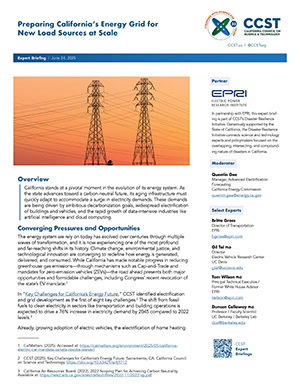
Panelists: Gross, Britta; Tal, Gil; Wilson, Tom; Callaway, Duncan; Gee, Quentin
Authors: Corzo, Héctor; Shybut, Mikel
Partners:
Video:
The energy system we rely on today has evolved over centuries through multiple waves of transformation, and it is now experiencing one of the most profound and far-reaching shifts in its history. Climate change, environmental justice, and technological innovation are converging to redefine how energy is generated, delivered, and consumed. While California has made notable progress in reducing greenhouse gas emissions—through mechanisms such as Cap-and-Trade and mandates for zero-emission vehicles (ZEVs)—the road ahead presents both major opportunities and formidable challenges, including Congress’ recent revocation of the state’s EV mandate.1
In “Key Challenges for California’s Energy Future,” CCST identified electrification and grid development as the first of eight key challenges.2 The shift from fossil fuels to clean electricity in sectors like transportation and building operations is expected to drive a 76% increase in electricity demand by 2045 compared to 2022 levels.3
Already, growing adoption of electric vehicles, the electrification of home heating systems, and rising air-conditioning needs during extreme heat events are placing additional strain on the grid. Meanwhile, emerging technologies like hydrogen production, carbon capture, and rapid expansion of data centers could introduce large, fast-growing new loads.
Meeting these rising demands will require large-scale upgrades to California’s transmission and distribution networks. The California Independent System Operator (CAISO) projects that $45.8 – $63.2 billion in investment will be needed for high-voltage transmission expansion by 2040.4 However, these upgrades face significant delays due to lengthy permitting processes, environmental assessments, and the need for coordination across jurisdictions.
Local distribution infrastructure is also under increasing pressure. Studies of PG&E’s service area show electric vehicle charging may necessitate upgrades to 20% or more of distribution feeder circuits, with one estimating significantly higher upgrades needed at total costs ranging from $1 billion to $10 billion.5,6 Without timely and coordinated planning, such localized bottlenecks could slow the pace of electrification. One tool to bridge this gap is EPRI’s interactive and publicly available eRoadMAP tool that projects EV charging loads over time at the individual feeder level. Additionally, their GridFAST platform facilitates collaboration by connecting customers with utilities for early EV infrastructure planning and right-sizing of the charging load with grid capacity.
While infrastructure investment is essential, technological innovation offers additional pathways to relieve pressure on the grid. Solutions like demand response, distributed energy resources, and advanced grid-enhancing technologies, including reconductoring with advanced materials, can provide greater flexibility in managing load – especially considering the inherent flexibility of a majority of vehicles that are parked long periods each day. Strategies such as load shifting—aligning energy consumption with periods of high renewable generation—and battery storage can help balance the grid and reduce reliance on costly new construction. At EPRI, the DCFlex Initiative field study is underway at production data centers to demonstrate their potential for flexibility.
California’s ability to meet its clean energy goals will depend not only on physical upgrades, but also on systemic improvements to policy, planning, and regulatory alignment. Streamlining permitting, expediting interconnection, and coordinating clean energy procurement are critical for accelerating progress. At the same time, equity must remain a central focus. Historically underserved communities, disproportionately impacted by pollution and energy insecurity, must share in the benefits of clean energy investments and grid modernization. Navigating this transition requires proactive coordination among utilities, regulators, community stakeholders, and large power users. By focusing on proactive planning and innovative tools, California can accelerate grid upgrades, enhance resilience, and ensure a reliable, equitable transition to a clean energy future.
1. CalMatters. (2025). Accessed at: https://calmatters.org/environment/2025/05/california-electric-car-mandate-senate-revoke-waiver/↩
2. CCST (2025). Key Challenges for California’s Energy Future. Sacramento, CA: California Council on Science and Technology. https://doi.org/10.63429/wifj9712↩
3. California Air Resources Board. (2022). 2022 Scoping Plan for Achieving Carbon Neutrality. Available at: https://ww2.arb.ca.gov/sites/default/files/2022-11/2022-sp.pdf↩
4. California ISO. (2024). 20-Year Transmission Outlook Update. Available at: https://www.caiso.com/documents/2024-20-year-transmission-outlook-jul-31-2024.pdf↩
5. Jenn, A and J. Highwayman. (2021). Distribution Grid Impacts of Electric Vehicles: A California Case Study. iScience 25(1):103686. doi: 10.1016/j.isci.2021.103686.↩
6. Elmallah, S., Brockway, M., Callaway, D. (2022). Environ. Res.: Infrastruct. Sustain. 2 045005. doi: 10.1088/2634-4505/ac949c↩