
Call for Experts: State Staff Academy on Emerging Technologies — Artificial Intelligence Module

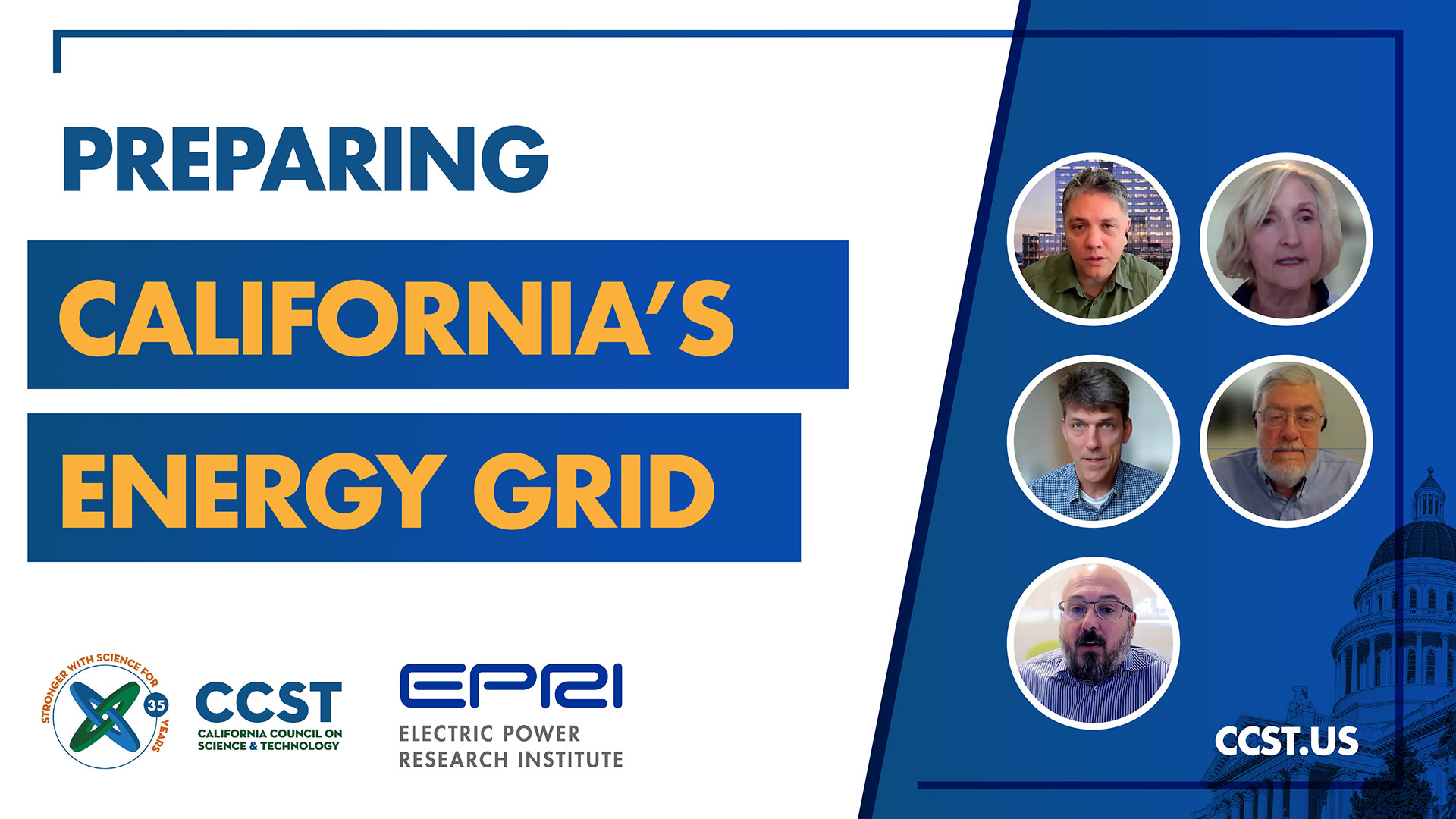
Watch: Preparing California’s Energy Grid for New Load Sources at Scale
June 16, 2025 | CCST Newsroom, Events, Expert Briefings
Description

As electrification rapidly expands across sectors, electric utilities face growing pressure to scale grid capacity to meet surging demand, particularly from electric vehicles (EVs), electrified buildings, and high-load data centers. This panel examines the specific challenges and opportunities facing California as it prepares its grid and infrastructure for this dramatic shift in electricity demand.
Watch
Recap: Quick Notes
- On the importance of flexible EV charging for managing grid loads: “Flexible EV charging is something that is so critical to be locking into now, as people are developing habits and expectations around when they get to fill up their EV, we need to be getting people to think about the issue. You don’t have to charge at home in a three hour window. It’s okay to move around when that charging is happening. And that’s going to have enormous dividends in terms of enabling us to navigate the infrastructure challenge, which we can separate from the energy delivery challenge.”
— Duncan Callaway, PhD, UC Berkeley / Berkeley Lab
- On opportunities to lower costs through better grid utilization: “What I’m mostly worried about is how do we get there? What we see in the light duty is that we have a very limited range for rate hikes. If driving electric will be more expensive than driving gas, cars, hybrids or others, we will not be able to meet the goals, the state goals of of electrification, not in the light duty and not in the heavy duty.”
— Gil Tal, PhD, UC Davis Electric Vehicle Research Center
- On the rapid growth of data center demand and EPRI’s DC Flex Initiative: “Data centers averaged about 20MW a few years ago, then up to 40MW. Now their requests for interconnection today are approaching 1GW, 2GW, and larger. So that’s the size of Minneapolis in terms of demand. If you’re at 2GW, quite large, one of the keys looking towards powering these data centers, just like with EVs, is flexibility.”
— Tom Wilson, PhD, EPRI / Former White House Advisor
- On a solutions-oriented approach with tools like EPRI’s eRoadMAP and GridFAST: “The most important thing we can do for utilities is to drive confidence in where and when the loads are coming, so that we can accelerate grid readiness and accelerate those interconnections on behalf of those customers with those loads. EPRI’s done a couple things in this EV scale initiative. Over the last two years, we have developed four important tools. We are very solution focused. What do we need to introduce into the market for customers and for utilities to work better together to plan?”
— Britta Gross, EPRI
Jump Straight to a Question
- What’s the nature of the load that we are preparing for in each sector?
- How are we thinking about the current infrastructure? How is it holding up?
- How can the sectoral growth and associated energy demand avoid harming biodiversity and other natural resources when deploying new power resources?
- Is there a mismatch between who pays for the distribution upgrades vs. who receives the benefits (project developers or ratepayers)?
- What are your thoughts on flexibility and managed charging?
- What are the barriers to meeting our SB 100 goals by 2045?
- If you had a magic wand, what would be a policy you would change or implement to prepare us for the load growth you expect us to see?
Panelists

Quentin Gee
Moderator
Manager, Advanced Electrification Forecasting
California Energy Commission
Duncan Callaway
Professor of Energy and Resources and affiliate in Electrical Engineering and Computer Science
UC Berkeley
Faculty Scientist
Berkeley Lab

Britta Gross
Director of Transportation
EPRI

Gil Tal
Professor and Director
STEPS+ Research Consortium and the Electric Vehicle Research Center
UC Davis

Tom Wilson
Principal Technical Executive, Integrated Grid and Energy Systems Division
EPRI
Partners