From Science to Action: Researchers and State Leaders Build Lasting Partnerships at Science Day 2026

Reducing Greenhouse Gas Emissions by 2050: California’s Energy Future
September 21, 2012 | CCST Newsroom, Press Releases | Contact: M. Daniel DeCillis
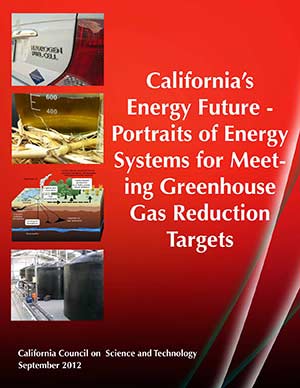 CCST has released the next report in the California’s Energy Future (CEF) series, which focuses on exploring possibilities for California’s energy strategy through the year 2050. Portraits of Energy Systems for Meeting Greenhouse Gas Reduction Targets examines a variety of scenarios for reducing greenhouse gas (GHG) emissions.
“We believe that the CEF energy system portraits report presents valuable insights into the possibilities and realities of meeting California’s future energy needs and GHG emissions targets by 2050,” said CEF co-chairs Jane Long, Principal Associate Director At Large and Fellow, Center for Global Security Research, Lawrence Livermore National Laboratory, and Miriam John, CCST Council Chair and Board Member, and Former Vice President, Sandia National Laboratories, in the introduction to the report.
The report – which is the fifth in the CEF series – documents two sets of portraits, detailed in the two main report sections: those that can reduce GHG emissions to 60% below the 1990 level by 2050, and those that can contribute toward reducing emissions all the way to the 80% reduction level, and beyond.
The document uses modeling and scenario building to explore combinations of technological approaches offering the best potential to reduce emissions. These approaches include energy efficiency, electrification, low-carbon electricity (from sources such as renewables, natural gas with carbon sequestration, or nuclear power) and low-carbon fuels derived, for example, from biomass.
The authors identify a mix of strategies that can reduce the state’s GHG emissions by 60 percent, and then calculate the impacts of ten additional individual strategies that could provide the extra 20 percent reduction the state needs to get to 80 percent reduction in emissions.
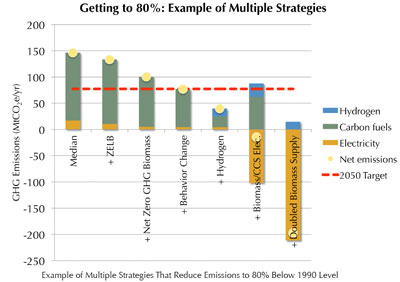
As noted in earlier CEF projects, no matter what strategy or combination of strategies are employed, achieving a full 80 percent reduction in emissions by 2050 will require significant levels of research, development, invention and innovation. The total commitment necessary to achieve this accelerated pace will require strong societal and policy backing because there are less than 40 years to make a nearly total change-over to the required technology, some of which has not yet been developed or deployed.
In addition to the initial CEF summary report, other documents released as part of the CEF project have focused on nuclear power, transportation energy use, and electricity from renewable energy and fossil fuels with carbon capture and sequestration. The CEF project is funded by the California Energy Commission, the S.D. Bechtel Foundation and the California Air Resources Board; reports have been completed committees of volunteers from major energy research institutions in the state.