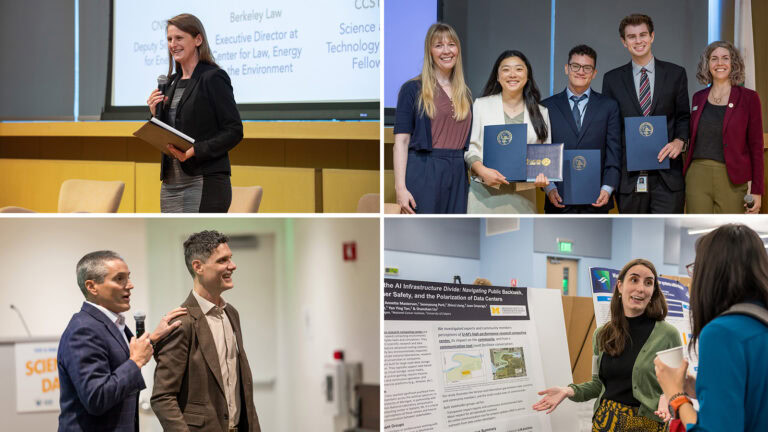
From Science to Action: Researchers and State Leaders Build Lasting Partnerships at Science Day 2026

CCST Releases Summary of Meetings on Trust and Accountability
January 13, 2011 | CCST Newsroom | Contact: M. Daniel DeCillis
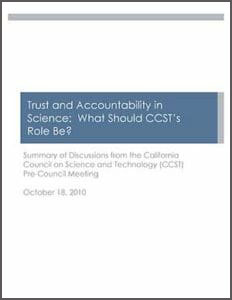 The October 2010 CCST Council meeting focused on trust and accountability in science and technology. Two summary documents are now available, with overviews of the discussions from October 18 and 19, respectively.
“Issues of trust and accountability in science are both timely and long-standing,” CCST Past Chair Charles Kennel said in his opening remarks at the meeting. “It shouldn’t come as a surprise that scientific authority is subject to questioning by the larger society, but when that authority is undermined – as illustrated by the ‘Climategate’ scandal in 2009 – overall trust in scientific methods and recommendations can falter as well.”
The meeting on October 18 focused on the role CCST should take with regards to the erosion of public trust in science and ways to address both real and perceived lapses in scientific accountability. CCST was created as an independent, impartial organization by the Legislature to advise the state on policy matters relating to science and technology.
The meeting on the 19th focused on broader issues, including:
- Scoping the issues of trust and accountability,
- What modeling of complex systems – from climate change to engineering to public education pipelines – can and cannot tell us,
- The science of trust (as illustrated by a neuroscientist’s research on oxycotin), and
- From the cosmos to the legislative chamber – highlights from the experiences of CCST’s first cohort of science and technology fellows completing a year in various legislative offices in Sacramento.
The documents provide detailed summaries of presentations from both days, along with comments and questions from other meeting participants. A list of participants and a brief list of resources and background papers are provided in appendices.
Among other things, it is important to find better ways to structure real dialogue between scientists, decision makers, and the public, said Kennel, in order to counter the undermining of public trust in recent years.
“The scientific community,” he said, “has a responsibility to understand how conflicts happened, and how to move forward.”
Updated with corrected version of Summaries from Day 2 at 6pm 1/13/11.