From Science to Action: Researchers and State Leaders Build Lasting Partnerships at Science Day 2026

Watch: Housing Costs, Insurance Rates, and Rebuilding After Disasters
June 6, 2025 | CCST Newsroom, Events, Expert Briefings

Description
Recent disasters have prompted us to rethink how and where we build, and challenged policymakers to develop strategies to protect assets, minimize costs, reduce community displacement, and prevent future catastrophic losses. Moderated by Doug Parsons, host of the America Adapts podcast, the second briefing in our climate change and human mobility series explores how disasters are affecting the costs of housing, insurance rates, and decisions by communities on whether to move away from at-risk areas.
Watch
Recap: Quick Notes
- On insurance as a carrot more than a stick: “There’s a huge opportunity here because when you think about insurance, it really provides this cross jurisdictional incentive. If we needed to get every single city and county to adopt the same exact plan, that’d be really challenging. But insurance crosses all those jurisdictions in the pricing incentives that are built in.”
— Michael Peterson, PhD, California Department of Insurance
- On whether we should rebuild in high risk areas: “When it comes to fire, there are places that can be rebuilt. The question is how they are rebuilt. … Places in Southern California, they can be mitigated. I think the real challenge is closing the gap between how to bring them up to code, even if they aren’t subject to the codes right now. … It’s so much cheaper to rebuild now, incorporating those [mitigation] features in the landscaping and in the building construction.”
— Molly Mowery, AICP, Community Wildfire Planning Center
- The expense of retrofitting compared to integrating mitigation into new builds or rebuilding: “One of the toughest challenges we have in California is that, of course, once we build homes, they last for decades — they’re long-lived fixed capital investments. And so the question is, how do we figure out what is cost effective to do for these homes that are in high hazard places, accepting the reality that a lot of the things we can do are going to be really expensive.”
— Judson Boomhower, PhD, Economics, UC San Diego
- On wildfire and the housing crisis: “The areas that burned are mostly single family homes. It’s really low density housing. And is there an opportunity to think about the housing crisis and creating more density, but creating it in a way that is smart and resilient so that we could actually have more housing in that area.”
— Sarah Atkinson, SPUR
Jump to a Question
- How have recent disasters affected housing cost and insurance availability?
- What should be prioritized to help reduce the costs of rebuilding?
- One big shift we need to make in how we plan for long-term resilience?
- Use insurance to get communities to invest before disaster strikes?
- Cost effective ways to protect older homes in high risk areas?
- Short- and long-term impacts of decreasing insurance availability?
- Examples of financial and land use tools to help better plan for disasters?
- What kind of policy changes to turn the tide on insurance availability?
- How should we rethink drivers of home value in high risk markets?
- How can we support communities with large number of renters in recovering?
- Examples where high risk fire communities are relocating?
- Any planning or insurance strategies to incentivize collective risk mitigation?
- Does moral hazard apply to insurance pricing in California?
- How do you envision overcoming the deficit in Federal funding and expertise?
- Magic wand to change one land use or housing policy in the US?
- Should we be rebuilding in areas of high risk after disasters?
- How can we integrate climate awareness with more immediate issues?
Panelists

Doug Parsons
Moderator
Director and Host
America Adapts Media, Podcast
Sarah Atkinson
Hazard Resilience Senior Policy Manager
SPUR

Judson Boomhower, PhD
Assistant Professor of Economics
UC San Diego

Molly Mowery, AICP
Executive Director
Community Wildfire Planning Center

Michael Peterson, PhD
Senior Deputy on Climate and Sustainability
California Department of Insurance
Partners


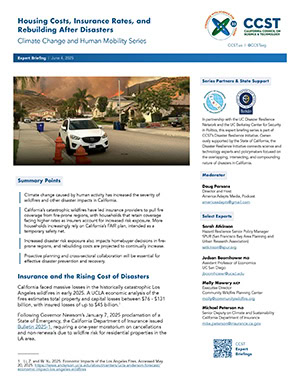
One Pager
###
About the California Council on Science and Technology
The California Council on Science and Technology is a nonpartisan, nonprofit organization established via the California State Legislature in 1988. CCST responds to the Governor, the Legislature, and other State entities who request independent assessment of public policy issues affecting the State of California relating to science and technology. CCST engages leading experts in science and technology to advise state policymakers—ensuring that California policy is strengthened and informed by scientific knowledge, research, and innovation.